
1. The Bioclimatic Role of Breathable Backsheets in Modern Hygiene
In modern disposable absorbent hygiene products, the exterior backsheet serves two fundamentally contradictory thermodynamic requirements: it must act as an impenetrable hydraulic barrier preventing liquid urine and bodily fluids from striking through onto bedding or clothing, while simultaneously functioning as a highly permeable vapor membrane that allows warm, humid air molecules to escape continuously into the ambient atmosphere. For decades, legacy disposable diapers utilized non-breathable cast polyethylene (PE) sheets. While inexpensive and liquid-proof, non-breathable plastic sheets trap perspiration and body heat, creating a suffocating, tropical microclimate inside the diaper chassis.
Under prolonged occlusion in a non-breathable diaper, relative humidity against the user’s perineal skin rapidly climbs to 100%, and localized skin temperature elevates by 2°C to 3°C. This combination of heat and trapped moisture induces severe cutaneous maceration: the stratum corneum—the outermost protective barrier of human epidermis—swells and softens, disrupting intercellular lipid bilayers and dramatically increasing vulnerability to mechanical chafing. Furthermore, fecal proteases and lipases become hyperactive in warm, wet conditions, breaking down epidermal proteins, while cutaneous microflora hydrolyze urinary urea into corrosive ammonia gas ($NH_3$). The catastrophic clinical result is Incontinence-Associated Dermatitis (IAD), severe diaper candidiasis, and Stage I-IV pressure ulcers in elderly patients.
To eliminate skin maceration and restore natural cutaneous respiration, Quanzhou Shenghongda Hygiene Products Co., Ltd. deploys advanced microporous breathable polyethylene backsheets across its entire converting portfolio, encompassing OEM Adult Diapers with Tapes, Baby Diapers OEM Manufacturing, Adult Incontinence Pull-Up Pants, and Feminine Sanitary Napkins Factory. Operating 16 full-servo converting lines under ISO 13485:2016 and ISO 9001:2015 standards, Shenghongda converts premium microporous films laminated with ultra-soft spunbond nonwovens, achieving Moisture Vapor Transmission Rates (MVTR) exceeding 3,500 g/m²/24h while guaranteeing zero liquid pinhole leakage.
By preventing skin maceration and maintaining natural epidermal pH equilibrium, Shenghongda’s breathable backsheet engineering provides international retail brand owners and medical tender syndicates with an unassailable clinical advantage across 88 export nations.
Clinical studies conducted across geriatric long-term care facilities and neonatal intensive care units (NICU) have demonstrated a direct causal correlation between diaper backsheet breathability and cutaneous bio-integrity. When non-breathable backsheets are utilized, trans-epidermal water loss (TEWL) values surge by more than 300% within two hours of voiding, indicating profound disruption of the epidermal stratum corneum barrier. In contrast, clinical evaluations of high-MVTR breathable backsheets confirm that trans-epidermal water loss remains within normal physiological baseline ranges (10 to 15 g/m²/h), while cutaneous surface temperature is maintained 1.8°C to 2.4°C cooler than in occlusive plastic garments. This measurable bioclimatic cooling effect prevents heat-induced vasodilation, suppresses pruritus (itching), and eliminates the warm, moist breeding environment required by opportunistic fungal pathogens such as Candida albicans.
Furthermore, our breathable films are formulated with medical-grade polyolefin resins that are 100% free of heavy metals, phthalate plasticizers, and toxic volatile organic compounds (VOCs), conforming strictly to European REACH and California Proposition 65 consumer safety benchmarks.
2. Polymer Compounding Chemistry, Calcium Carbonate ($CaCO_3$) Micro-Cavitation & MDO Physics
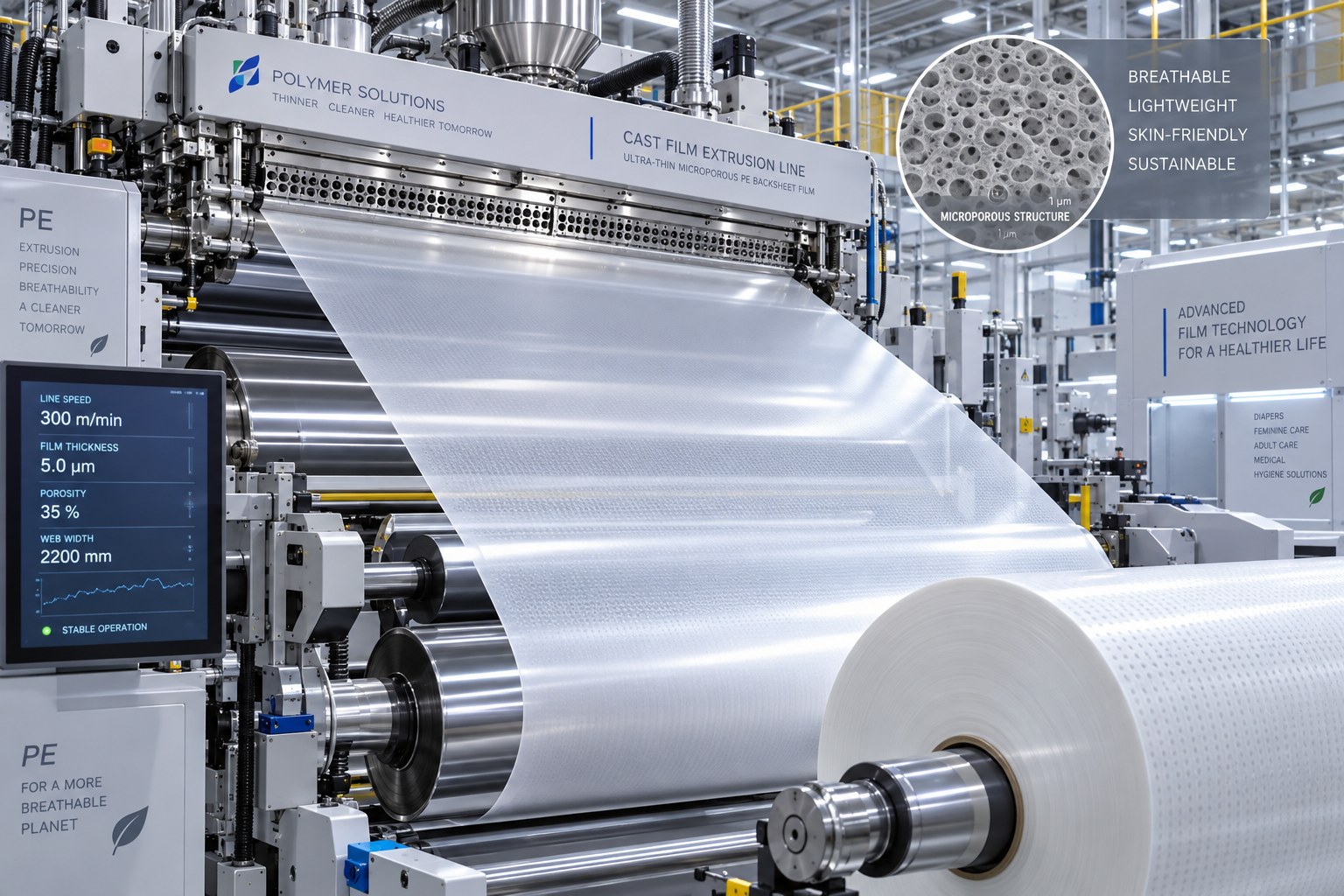
Understanding how a solid plastic film can breathe vapor while blocking liquid requires examining polymer morphology and the physics of machine-direction orientation (MDO) micro-cavitation. Breathable polyethylene backsheet film is not perforated using mechanical pins or needles—which would create macroscopic holes through which liquid urine would instantly leak under seated bodyweight. Instead, breathable film relies on sub-micron micro-porosity engineered directly into the polymer matrix during extrusion compounding.
The raw material formulation comprises a masterbatch of Linear Low-Density Polyethylene (LLDPE) and High-Density Polyethylene (HDPE) compounded with ultra-pure, micro-fine precipitated calcium carbonate ($CaCO_3$) powder. Calcium carbonate content represents between 45% and 55% of the total film weight. The $CaCO_3$ particles are precision-milled to an exact particle size diameter of 1.0 to 2.5 microns and surface-treated with hydrophobic stearic acid coatings to ensure uniform dispersion within the molten polyolefin matrix.
During the extrusion process, the molten polymer-calcium blend is cast into a precursor film through precision slot dies. Once cooled, this precursor film is fed into a specialized Machine-Direction Orientation (MDO) stretching unit consisting of differential-speed heated rollers. Under controlled thermal conditions (typically 75°C to 95°C), the film is longitudinally stretched to 3.0 to 4.5 times its original length. Because the rigid, crystalline calcium carbonate particles cannot stretch, the ductile polyethylene polymer chains debond and pull away from the surfaces of the $CaCO_3$ particles, creating billions of microscopic, tortuous interconnected void channels throughout the film thickness.
The molecular engineering of the polyethylene resin blend is critical to achieving uniform micro-pore cavitation. Shenghongda utilizes bimodal Linear Low-Density Polyethylene (LLDPE) synthesized via metallocene catalyst technology. Metallocene LLDPE exhibits narrow molecular weight distribution and precise short-chain branching, providing high tensile elongation and puncture resistance at low extrusion calipers. During Machine-Direction Orientation (MDO), the polymer chains undergo localized stress-induced crystallization around the surface-treated calcium carbonate particles. The stearic acid surface coating on the CaCO3 particles reduces interfacial adhesion energy, facilitating clean interfacial debonding without micro-void tearing or resin fibril fracture.
The resulting sub-micron pores have an average diameter of 0.1 to 1.0 microns. In physics, a single water molecule in vapor phase has an kinetic diameter of approximately 0.0003 microns (0.3 nanometers), allowing it to navigate through the micro-pores freely by molecular diffusion. Conversely, liquid water molecules are bound by powerful intermolecular hydrogen bonds, forming liquid droplets with surface tension that prevents them from entering pore channels smaller than 1.0 micron under pressures below 25 kPa. Consequently, the MDO-stretched film exhibits complete liquid impermeability while transmitting water vapor at rates exceeding 3,500 g/m²/24h, achieving the perfect bioclimatic equilibrium.
| Technical Parameter / Feature | Standard Non-Breathable PE Sheet | Commodity Breathable Blown Film | Shenghongda MDO Cast Breathable Film | Clinical & Manufacturing Significance |
|---|---|---|---|---|
| Film Extrusion Technology | Standard blown / cast extrusion | Blown film with basic stretching | High-speed cast extrusion + MDO stretch | Cast MDO delivers superior gauge uniformity |
| Calcium Carbonate Loading | 0% (Pure polyethylene) | 35% - 42% CaCO₃ (Coarse grade) | 48% - 52% Ultra-fine stearic-coated CaCO₃ | High loading creates dense micro-pore network |
| Pore Size Geometry | No pores (Solid plastic sheet) | 0.5 - 3.5 µm (Variable pore size) | 0.1 - 1.0 µm (Uniform sub-micron pores) | Sub-micron pores block liquid while releasing vapor |
| Moisture Vapor (MVTR ASTM E96) | < 100 g/m²/24h (Zero breathability) | 1,200 - 1,800 g/m²/24h (Low breathability) | ≥ 3,500 g/m²/24h (Ultra-high breathability) | Eliminates heat rash and skin maceration |
| Hydrostatic Head Resistance | ≥ 300 mm H₂O (Liquid proof) | 140 - 180 mm H₂O (Pinhole risk) | ≥ 250 mm H₂O (Zero liquid strike-through) | Guarantees complete leak-free security |
| Tensile Strength (MD / CD) | MD ≥ 18 N/5cm; CD ≥ 12 N/5cm | MD ≥ 14 N/5cm; CD ≥ 8 N/5cm | MD ≥ 22 N/5cm; CD ≥ 14 N/5cm | Prevents web breaks on 500 ppm converting lines |
3. High-Speed Cast Film Extrusion Lines, Mono-Axial Stretching & Pinhole Vision Detection
Manufacturing ultra-thin, high-breathability polyethylene films with basis weights as low as 14 to 18 g/m² requires extrusion machinery of extraordinary technological sophistication. Minor fluctuations in extrusion melt temperature, polymer melt fracture, or uneven MDO stretching ratios can produce catastrophic pinholes, localized gauge variations, or weak spots that rupture on high-speed diaper converting lines. Shenghongda’s film manufacturing partners operate world-class European Reifenhauser and Japanese cast film extrusion lines.
The extrusion process begins with continuous multi-component gravimetric dosing systems that blend virgin polymer resins, calcium carbonate masterbatch, titanium dioxide ($TiO_2$) for opacity, and specialized processing aids with an accuracy of ±0.1%. Molten polymer at 210°C to 230°C is extruded through automated thermal-expansion slot dies featuring internal deckling systems, casting the melt onto high-precision vacuum chill rolls with internal water-cooling circuits. Online beta-gauge radiometric sensors continuously scan the web across its entire width at 10 Hz, feeding back to automated thermal die bolts to maintain cross-directional thickness tolerances within ±0.3 microns.
Following casting, the web enters the inline MDO stretching unit. Precisely calibrated oil-heated rollers stretch the film longitudinally under an exact multi-stage thermal profile, opening the micro-voids without tearing the polyolefin web. Following stretching, the film passes through an inline annealing and cooling zone that relieves internal molecular stress, preventing post-extrusion shrinkage and ensuring dimensional stability during high-temperature diaper converting operations.
Furthermore, modern high-speed converting lines demand exceptional surface wettability and corona discharge treatment for printing and adhesive bonding. Shenghongda’s breathable film lines incorporate inline high-frequency corona treating stations that bombard the moving film surface with high-voltage electrical plasma in ambient air. This plasma treatment oxidizes surface polymer chains, grafting polar carbonyl, carboxyl, and hydroxyl functional groups onto the non-polar polyethylene surface. This increases the critical surface tension (surface free energy) of the breathable film from an untreated baseline of 30 Dyne/cm up to an optimized 38 to 42 Dyne/cm, ensuring absolute adhesion of non-toxic flexographic printing inks and eliminating the risk of ink flaking or rub-off during diaper conversion.
To guarantee 100% pinhole-free integrity across millions of square meters of film, the production line incorporates advanced inline high-voltage spark (corona) pinhole detection and high-resolution CCD optical surface inspection systems. The high-voltage spark tester subjects the moving film to continuous electrostatic discharge: if a microscopic physical pinhole passes over the grounded roller, a spark discharges through the hole, triggering an immediate encoder flag that marks the exact roll location. Simultaneously, optical cameras inspect for gel specks, un-melted resin lumps, and calcium agglomerates down to 0.1 mm², ensuring that zero defective film rolls are ever shipped to our diaper converting lines.
4. Laboratory Moisture Vapor Transmission Rate (MVTR) Testing & Hydrostatic Barrier Validation
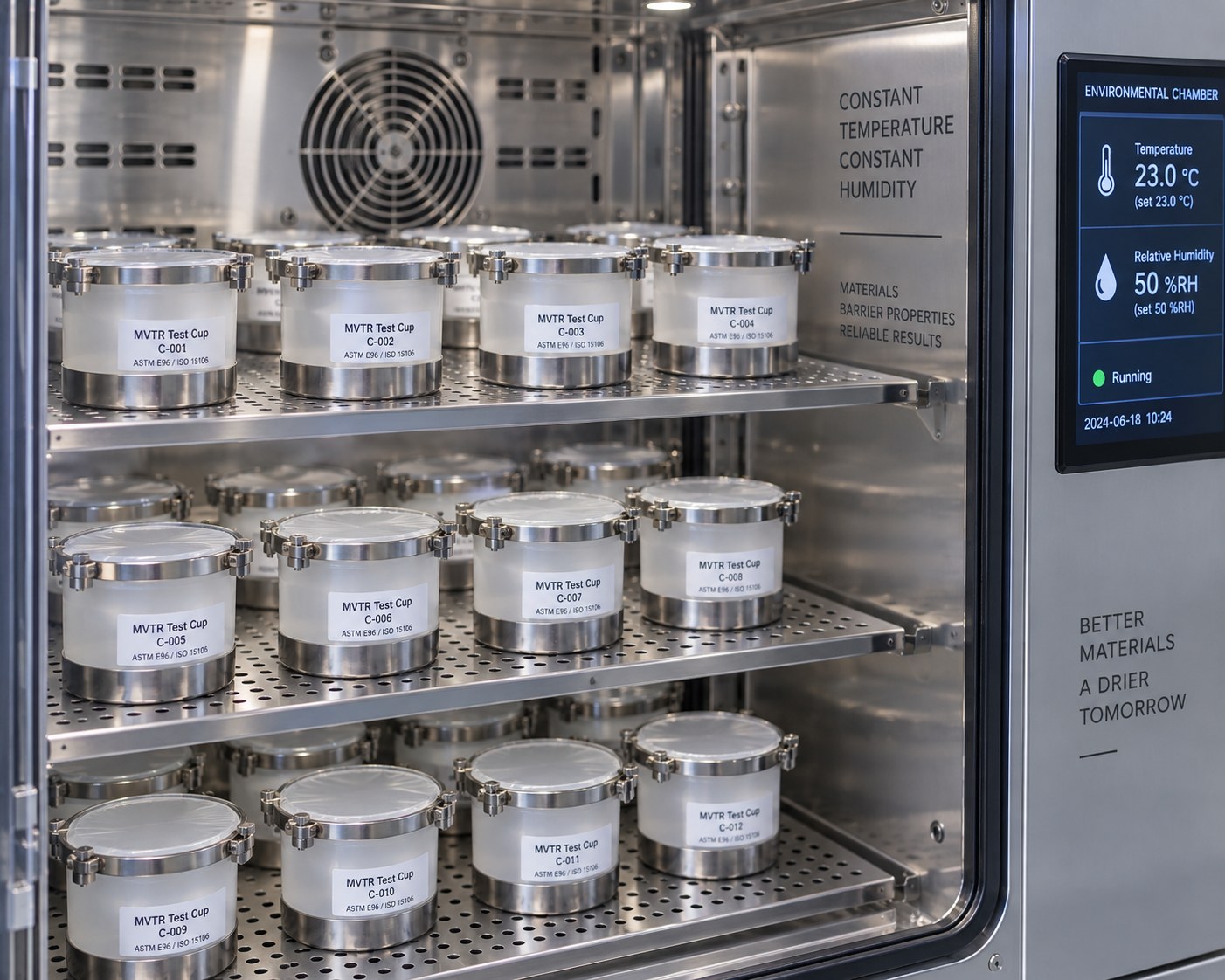
To substantiate clinical claims and ensure unyielding batch-to-batch quality, Shenghongda’s CNAS-accredited quality testing laboratory conducts continuous physical and barrier testing on every production lot of breathable backsheet film. Testing bridges both vapor permeability kinetics and liquid barrier resistance under extreme hydrostatic pressures.
The primary global gold standard for assessing breathability is the Moisture Vapor Transmission Rate (MVTR) test, conducted in accordance with ASTM E96 (Standard Test Methods for Water Vapor Transmission of Materials) Water Method and Desiccant Method, as well as JIS Z 0208 protocols. In our automated testing setup, film specimens are hermetically clamped over precision aluminum test cups containing anhydrous calcium chloride desiccant. The assembled test assemblies are placed inside an environmental conditioning chamber maintained at precisely 38°C ± 0.5°C and 90% ± 2% relative humidity. The cups are weighed on high-precision analytical balances (0.0001 g resolution) at calibrated 2-hour intervals over a 24-hour test period. The rate of weight gain reflects the mass of water vapor transmitted through the film area, calculated in grams per square meter per 24 hours ($g/m^2/24h$). Shenghongda’s premium films consistently record verified MVTR values of 3,500 to 4,500 g/m²/24h, providing maximum skin aeration.
Simultaneously, liquid barrier capability is evaluated under ISO 1420 and EDANA NWSP 120.1 hydrostatic head pressure protocols. The breathable film is clamped into a test chamber where water pressure is increased at a continuous rate of 10 cm H₂O per minute. The film must withstand a sustained hydrostatic water column pressure exceeding 250 mm H₂O before any liquid droplet penetrates the micro-pores. This ensures that even when a heavy adult patient sits firmly on a saturated diaper, the hydrostatic pressure will not force liquid urine through the backsheet.
In addition to standard ASTM E96 desiccant cup methods, Shenghongda validates moisture vapor dynamics using advanced continuous-flow electrolytic detection instruments (conforming to ISO 15106-3 and DIN 53122). In these automated analyzers, a carrier gas stream transports water vapor permeating through the film directly across an electrolytic cell containing phosphorus pentoxide ($P_2O_5$). The electrolytic current required to continuously dissociate the absorbed water into hydrogen and oxygen yields instantaneous, real-time MVTR measurements with precision down to 0.01 g/m²/24h, confirming that every square meter of film leaving our facility conforms to target breathability specifications.
Mechanical tensile properties are evaluated on universal testing machines in accordance with ASTM D882:
- Machine Direction (MD) Tensile Strength: Enforced at ≥ 22 N/5cm with elongation between 120% and 180%, ensuring the film withstands high-speed converting line tensions without stretching out of register.
- Cross Direction (CD) Tensile Strength: Enforced at ≥ 14 N/5cm with elongation > 350%, providing lateral flexibility that conforms smoothly to body movement.
- Elmendorf Tear Resistance: Tested under ASTM D1922 to verify high tear propagation resistance, preventing side-tab tear-outs during vigorous fastening.
| Performance & Commercial Factor | Generic Commodity PE Film | Shenghongda High-MVTR Cast Film | Clinical & Brand Advantage for Buyers |
|---|---|---|---|
| Moisture Vapor Rate (MVTR) | Non-breathable (<100 g/m²/24h) | ≥ 3,500 g/m²/24h (Certified) | Actively prevents diaper rash and skin maceration |
| Hydrostatic Head Resistance | Variable; pinhole prone (<120 mm) | ≥ 250 mm H₂O (Pinhole free) | Guarantees 100% leak protection under bodyweight |
| Tactile Hand & Crinkle Noise | Noisy, stiff plastic rustling | Whisper-quiet, cloth-like hand feel | Provides discreet, dignified wear for adult users |
| Converting Line Web Stability | Frequent gauge bands & web flutter | ±0.3 µm gauge tolerance; zero flutter | Runs smoothly at 500 ppm converting line speeds |
| Container Packing Payload | 70,000 - 74,000 pcs / 40HQ | 92,000 - 96,000 pcs / 40HQ | +28% higher piece count; $0.024/pc ocean freight savings |
| Regulatory Compliance Dossier | Lacks biocompatibility testing | Full ISO 10993 & Prop 65 certified | Frictionless regulatory registration across EU/US |
5. Cloth-Like Nonwoven Lamination, Ultrasonic Gluing & Noiseless Drape Engineering
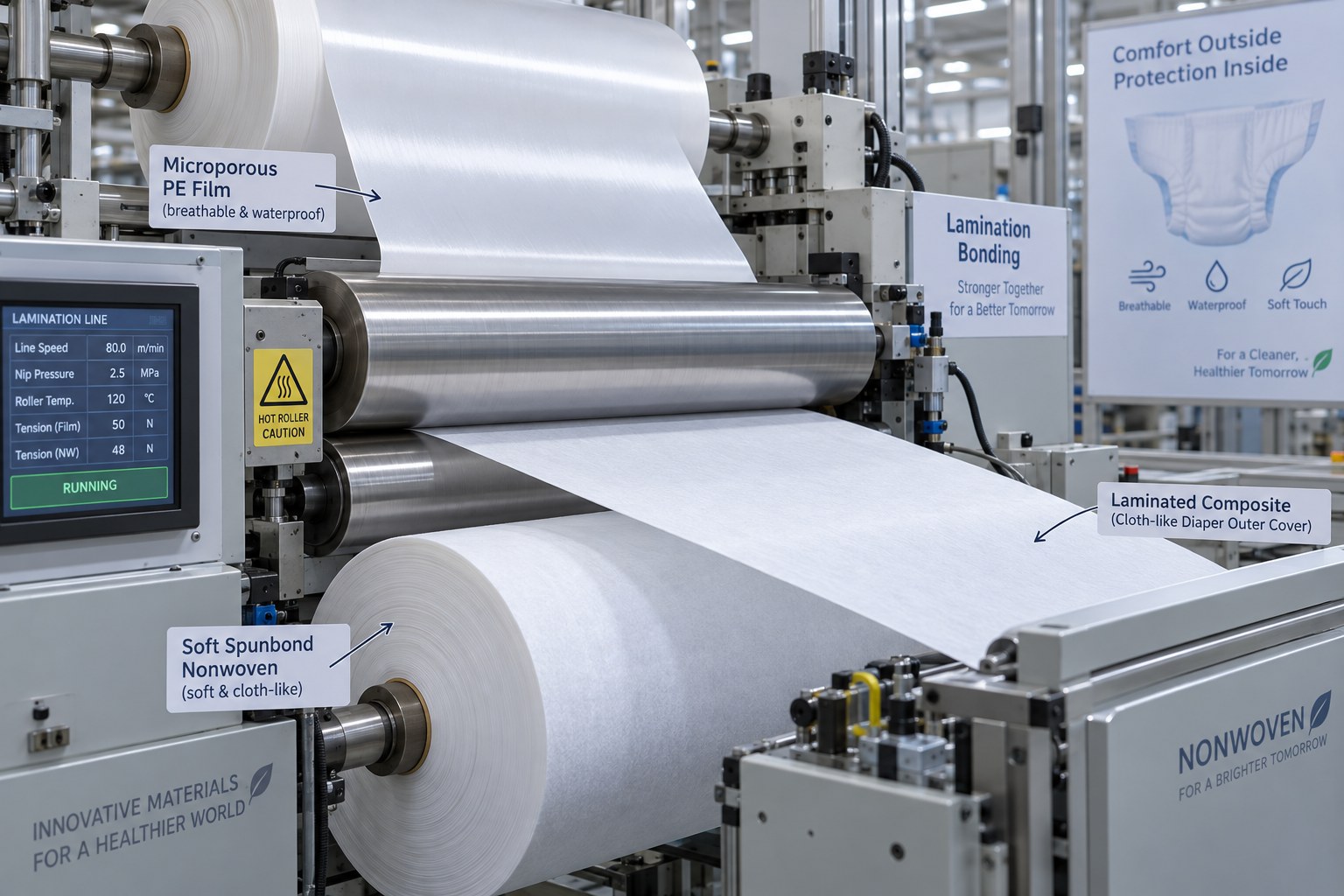
While the microporous polyethylene film provides the essential hydraulic barrier and breathability, modern consumers and healthcare professionals reject bare plastic backsheets. A bare plastic diaper feels cold against the skin, adheres uncomfortably when sweating, and generates embarrassing rustling crinkle noises during walking. To deliver the luxurious, cloth-like aesthetic demanded in premium retail and institutional healthcare markets, Shenghongda laminates the breathable PE film with an exterior layer of ultra-soft spunbond polypropylene nonwoven.
Laminating ultra-thin breathable film (14 to 18 g/m²) with lightweight spunbond nonwoven (12 to 15 g/m²) requires extreme process control. If conventional heavy adhesive coatings are applied, the hot-melt glue forms a solid barrier film between the nonwoven and PE layers, blocking the microscopic breathability pores and destroying up to 60% of the film’s MVTR. Furthermore, excess adhesive stiffens the laminate, ruining its textile drape and increasing manufacturing costs. Shenghongda resolves this engineering challenge by employing advanced contactless micro-fiber spray and porous slot-die lamination systems developed by German leader Nordson.
Our lamination lines utilize specialized low-application-temperature hot-melt adhesives applied in an open, breathable multi-filament swirl pattern with an ultra-low add-on weight of only 1.2 to 1.8 g/m². The adhesive filaments bond the nonwoven fibers to the film without bridging or sealing the sub-micron $CaCO_3$ pores, preserving over 92% of the unlaminated film’s intrinsic MVTR. Alternatively, for our ultra-premium eco-friendly lines, Shenghongda utilizes ultrasonic lamination technology, fusing the polyolefin layers together using high-frequency acoustic welding horns without any hot-melt adhesives whatsoever.
Aesthetic customization is another area of technical leadership. Modern retail brands demand subtle, elegant pastel backsheet designs and functional wetness indicators. Shenghongda deploys central-impression (CI) high-speed flexographic printing presses using 100% water-based, non-toxic, heavy-metal-free inks. For wetness indication, our lines apply hot-melt color-changing indicators that transition crisply from golden yellow to vivid ocean blue upon contact with urine (pH > 6.0). The indicator formulation is specifically engineered to resist premature color change triggered by high ambient humidity or sweat, ensuring that nursing staff and parents receive unmistakable visual cues only when a diaper genuinely requires replacement.
The resulting textile laminate delivers whisper-quiet acoustic performance. Evaluated on dynamic acoustic sound chambers, Shenghongda’s cloth-like backsheets generate less than 28 decibels of friction noise during walking movement—well below the ambient threshold of normal conversation—providing adult incontinence sufferers with complete discretion, dignity, and confidence in social environments.
6. Cleanroom Extrusion Controls, Static Dissipation & Volatile Organic Compound (VOC) Elimination
The manufacture of breathable hygiene films involves intimate medical applications that demand uncompromising sanitary and environmental cleanliness. Breathable films incorporate vast surface areas of microporous void channels; if extrusion or converting operations occur in uncertified industrial environments, airborne particulates, mold spores, and volatile chemical fumes can become entrapped within the micro-pores, posing acute microbiological and chemical toxicity risks to end users.
All breathable film converting and lamination operations at Shenghongda take place inside our certified Class 100,000 (ISO Class 8) cleanroom manufacturing complex, operated under strict ISO 13485:2016 medical device and ISO 9001:2015 quality management governance. The facility utilizes continuous positive air pressure differentials (+15 to +25 Pa) and three-stage HEPA filtration delivering 20 air changes per hour, preventing external environmental dust, airborne lint, or micro-insects from entering the production zone.
Polyethylene extrusion and high-speed unwinding naturally generate intense electrostatic surface charges—frequently exceeding 15,000 to 20,000 Volts. In unmanaged environments, static electricity acts as an irresistible magnet for airborne dust and causes sudden electrostatic discharges that can puncture ultra-thin films. Shenghongda deploys active closed-loop ionizing bars from Fraser Anti-Static Techniques across all unwinding and lamination stations, continuously neutralizing electrostatic charges to below 100 Volts across the moving web.
Furthermore, chemical odor and volatile organic compound (VOC) elimination is strictly controlled. Low-grade breathable films often release pungent paraffin or chemical solvent odors caused by oxidized low-molecular-weight polymer waxes or degraded processing additives. Shenghongda mandates 100% medical-grade virgin resins with zero recycled regrind, coupled with multi-stage vacuum degassing vents on extruders that extract volatile monomers and odoriferous compounds during the melt phase. Finished films undergo gas chromatography-mass spectrometry (GC-MS) headspace analysis, confirming total VOC concentrations strictly below 50 µg/g and absolute zero detection of benzene, toluene, or chlorinated solvents.
7. Strategic Sourcing Due Diligence Roadmap & Buyer Action Checklist for Breathable Films
For international procurement directors, healthcare tender managers, and consumer goods brand executives seeking to evaluate a diaper manufacturer's breathable backsheet film quality, Shenghongda recommends the following 7-step operational due diligence roadmap:
- Step 1: Audit Film Extrusion Technology & Compounding Formulations
Review the prospective manufacturer's technical specifications: verify whether breathable backsheets are manufactured using MDO cast film technology with stearic-coated calcium carbonate compounding or cheap un-stretched blown films.
- Step 2: Moisture Vapor Transmission Rate (MVTR) Laboratory Verification
Demand certified third-party laboratory test reports under ASTM E96 confirming verified MVTR ratings exceeding 3,500 g/m²/24h, ensuring that the finished product actively prevents skin maceration and heat rash.
- Step 3: Hydrostatic Head Pressure & Zero Pinhole Testing
Review quality records for hydrostatic column resistance (ISO 1420 ≥ 250 mm H₂O) and verify that extrusion lines deploy 100% inline high-voltage spark pinhole detection to prevent liquid leakage.
- Step 4: Cloth-Like Nonwoven Lamination & Acoustic Noise Audit
Evaluate the exterior textile lamination: confirm breathable open-swirl adhesive application (<1.8 g/m²) or ultrasonic bonding that preserves MVTR while ensuring quiet, rustle-free wear (<28 dB).
- Step 5: Biocompatibility & Chemical Safety Review
Review certified GLP testing reports for in-vitro cytotoxicity (ISO 10993-5), skin irritation (ISO 10993-10), and complete compliance with California Proposition 65 thresholds (lead < 100 ppm, phthalates < 0.1%, zero toxic VOCs).
- Step 6: High-Density Container Loading & Sinosure Credit Setup
Collaborate with Shenghongda's logistics engineers to simulate high-density vacuum compression load plans for 40HQ ocean containers. Finalize maritime shipping schedules from Xiamen Port and apply for Sinosure Open Account (OA) credit facilities to optimize working capital during product rollout.
- Step 7: Structured Post-Production Quality Auditing
Implement incoming batch inspection protocols at destination distribution centers: verify tactile softness ratings, barrier cuff hydrostatic resistance, and packaging integrity to ensure continuous brand excellence.