
1. The Metrology Imperative: Expanding Shenghongda's CNAS-Accredited Testing Center
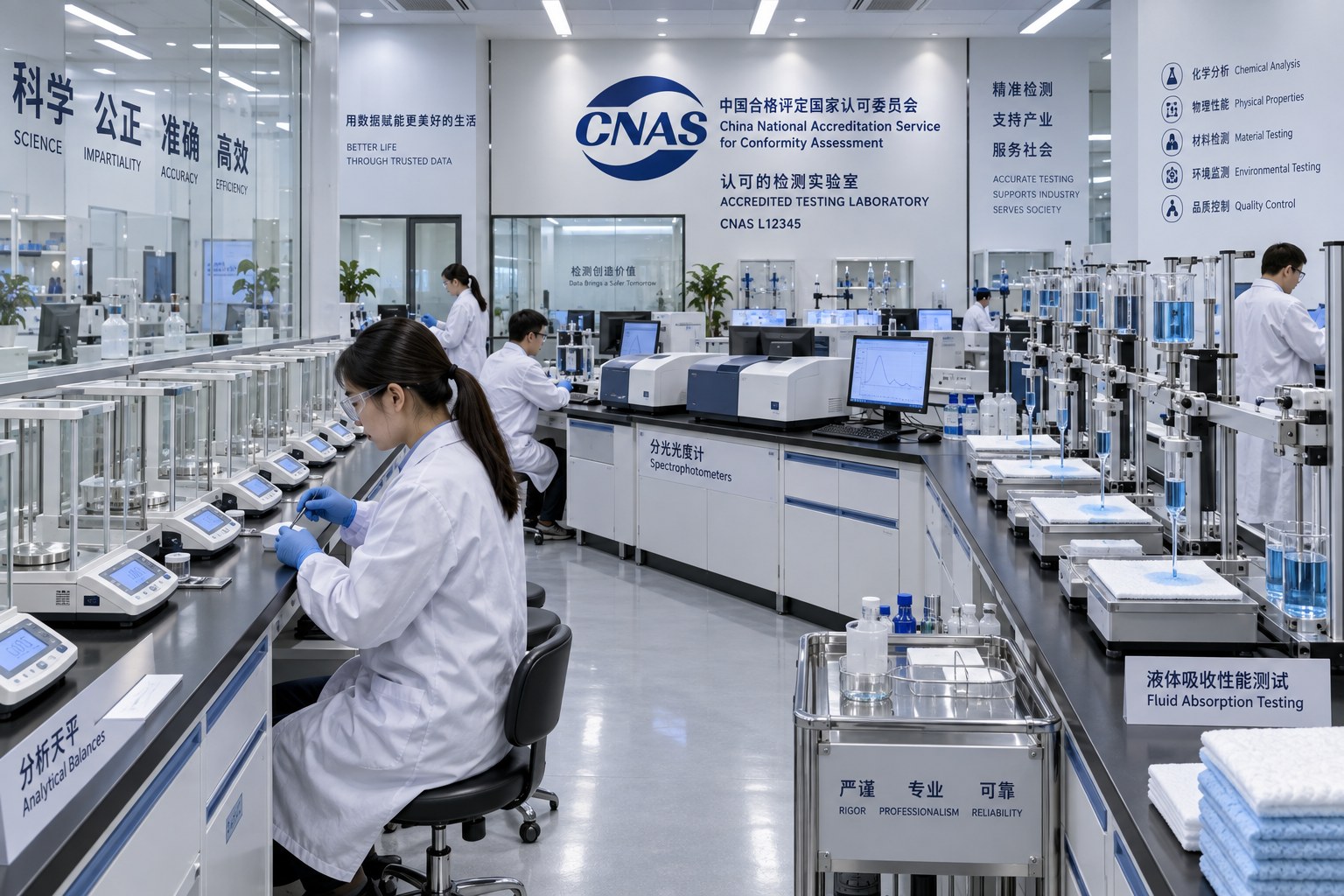
In July 2026, Quanzhou Shenghongda Hygiene Products Co., Ltd. announced the formal completion and operational commissioning of its newly expanded, 1,200 square meter Advanced Absorbent Materials & Fluid Kinetics Testing Center at its Quanzhou manufacturing campus. Operated in strict compliance with ISO/IEC 17025:2017 (General requirements for the competence of testing and calibration laboratories) and holding national accreditation from the China National Accreditation Service for Conformity Assessment (CNAS National Accreditation), this multi-million-dollar metrological investment establishes one of the most advanced analytical nonwovens laboratories in the global hygiene converting sector.
In the contemporary B2B hygiene supply landscape, documentary claims are no longer sufficient. International supermarket conglomerates, pharmaceutical pharmacy syndicates, and public healthcare procurement authorities demand unassailable empirical proof of product performance, chemical safety, and mechanical durability. In past decades, unverified free-swell capacity figures and subjective softness claims allowed low-grade converters to mislead buyers. Today, rigorous international standards—including ISO 11948-1 (Rothwell Method) (Rothwell Method), European EDANA Standards harmonized test methods, and US U.S. FDA biocompatibility mandates—require calibrated, reproducible laboratory instrumentation capable of measuring fluid kinetics, micro-gram surface rewet, and trace chemical purity under controlled environmental conditions.
Shenghongda’s expanded testing center supports our 16 full-servo converting lines producing over 1.2 billion units annually across OEM Adult Diapers with Tapes, Adult Incontinence Pull-Up Pants, Disposable Hospital Bed Underpads, Baby Diapers OEM Manufacturing, and Feminine Sanitary Napkins Factory.
To further advance raw material research, Shenghongda’s testing center operates an automated Contact Angle Goniometer (Krüss GmbH) for evaluating dynamic nonwoven surface wettability. By analyzing micro-droplet contact angles on hydrophilic topsheet fibers at 1,000 frames per second, technicians measure surfactant distribution uniformity and liquid penetration dynamics with sub-millisecond precision. This guarantees that topsheets achieve immediate liquid wetting without surfactant wash-off during prolonged wear.
In addition, our physical testing suite includes dynamic fluid strike-through under mechanical compression benches. Saturated samples are subjected to rolling cylinder shear forces while receiving secondary fluid insults, simulating the real-world biomechanics of an active infant crawling or an adult turning in bed. This advanced testing ensures that our products prevent surface moisture re-emergence under all dynamic movement postures.
By housing cutting-edge analytical instrumentation from Japanese Shimadzu Corporation, German Datacolor, and American Textest Instruments, the testing center serves as an authoritative guardian of quality, guaranteeing that every export shipment dispatched to our distribution partners across 88 nations delivers flawless clinical performance.
The metrological infrastructure of Shenghongda’s testing center is grounded in the international requirements of ISO/IEC 17025. Laboratory ambient conditions are continuously regulated by dedicated precision environmental control systems maintaining 23.0°C ± 1.0°C and 50.0% ± 2.0% relative humidity, conforming to EDANA NWSP 001.0 testing atmosphere specifications. All analytical balances, electronic load cells, spectrophotometers, and digital micrometers undergo regular traceable calibration by the National Institute of Metrology (NIM) of China, ensuring absolute international measurement traceability.
Furthermore, testing technicians undergo rigorous ongoing competency evaluations and blind round-robin testing to eliminate measurement drift. All testing data is captured automatically via direct instrument interfaces into our Laboratory Information Management System (LIMS), eliminating manual paper logs and preventing data manipulation.
To substantiate international metrological authority, Shenghongda participates actively in international inter-laboratory proficiency testing programs organized by EDANA and ASTM International, consistently achieving Z-scores within |Z| <= 0.5 across fluid absorption, surface rewet, and tensile strength evaluations, validating that our automated workstations deliver measurement precision fully aligned with the world’s leading nonwovens research institutes.
2. Advanced Instrumentation Architecture: HPLC, GC-MS & Atomic Absorption Spectrometry
The technical crown jewel of Shenghongda’s expanded testing center is its advanced chemical and toxicological chromatography suite. As international consumer product safety regulations tighten—most notably European REACH (EC 1907/2006) Substances of Very High Concern (SVHC), EU Medical Device Regulation (European CE MDR (EU 2017/745)), and California Proposition 65—hygiene products must be certified free of toxic chemical residues, heavy metal contaminants, volatile organic compounds (VOCs), and endocrine disruptors.
Shenghongda’s analytical laboratory houses three core analytical instrument systems:
- Shimadzu High-Performance Liquid Chromatography (HPLC) & LC-MS/MS: Used to screen and quantify trace organic compounds, plasticizer additives, optical brightening agents (OBAs), and pesticide residues in raw cotton and botanical bamboo fibers. The instrument achieves detection limits down to parts-per-billion (ppb) sensitivity, ensuring that zero forbidden chemical additives enter our production streams.
- Shimadzu Gas Chromatography-Mass Spectrometry (GC-MS): Dedicated to headspace volatile organic compound (VOC) profiling, residual solvent screening in hot-melt adhesives from Henkel Adhesives (Germany), and phthalate ester quantification. This testing guarantees that our diapers release zero hazardous chemical off-gassing, protecting infant respiratory health and sensitive geriatric users.
- Atomic Absorption Spectrometry (AAS) & ICP-OES: Calibrated to detect heavy metal trace contaminants—including lead (Pb), cadmium (Cd), mercury (Hg), and arsenic (As)—in superabsorbent polymers from Sumitomo Seika Chemicals (Japan) and virgin wood fluff pulp from Weyerhaeuser Company (USA), ensuring 100% compliance with OEKO-TEX Standard 100 Class I ceilings.
In addition to HPLC and GC-MS instrumentation, the chemical laboratory houses an advanced PerkinElmer Inductively Coupled Plasma Optical Emission Spectrometer (ICP-OES). This instrument performs multi-element screening for 24 toxic and heavy metals simultaneously down to sub-part-per-billion detection thresholds. Raw materials—including superabsorbent polymers, botanical bamboo fibers, and hot-melt adhesives—are digested in ultra-pure nitric acid within microwave digestion autoclaves before analysis, ensuring that finished products contain non-detectable levels of lead, arsenic, mercury, cadmium, nickel, and antimony.
Fourier-Transform Infrared Spectroscopy (FTIR) with Attenuated Total Reflectance (ATR) accessories is utilized for incoming polymer identification and fingerprinting. Every incoming lot of polypropylene nonwoven or polyethylene film is scanned to verify polymer purity, degree of crystallinity, and absence of degraded polymer fractions, preventing material substitution and guaranteeing consistent thermal welding behavior.
Every raw material supplier lot must pass comprehensive chemical screening before warehouse release, providing our private-label brand clients with an ironclad guarantee of toxicological purity.
| Testing Domain / Parameter | Laboratory Analytical Instrument | Governing Standard / Test Protocol | Detection Limit / Sensitivity | Quality & Safety Significance |
|---|---|---|---|---|
| Total Fluid Absorption Capacity | Automated Rothwell ISO 11948-1 Station | ISO 11948-1 / EDANA NWSP 241.0 | Analytical balance ±0.01 g | Guarantees verified retention up to 3,500 ml for hospital tenders |
| Surface Rewet Under Load | Lister & Automated Rewet Dead-Weight | EDANA NWSP 070.1.R2 (0.5 psi) | Digital balance ±0.001 g | Validates ultra-low rewet <0.05g; prevents clinical skin maceration |
| Fluid Strike-Through Speed | Textest FX 3180 Strike-Through Tester | EDANA NWSP 070.4 / ISO 9073-8 | Electronic timer ±0.01 s | Measures instantaneous fluid uptake under 1.5 seconds |
| Trace Volatile Organics & Phthalates | Shimadzu GC-MS QP2020 NX System | EPA 8260D / CPSC-CH-C1001-09.4 | Detection limit < 0.05 ppm | Guarantees zero toxic VOC off-gassing or plasticizer migration |
| Mechanical Tensile & Peel Strength | Shimadzu AGS-X Dual-Column Tester | ASTM D882 / ASTM D1876 / NWSP 110.4 | Load cell 500 N (±0.2% accuracy) | Validates hook-and-loop peel >3.8 N/25mm after 5 cycles |
| Hydrostatic Barrier Column | Textest FX 3000 Hydrostatic Head Tester | ISO 1420 / AATCC 127 | Pressure sensor ±0.5 mm H₂O | Ensures standing leg cuffs withstand >220 mm H₂O pressure |
3. Automated Rothwell (ISO 11948-1) & Lister Strike-Through Testing Workstations
In the evaluation of absorbent hygiene articles, fluid management behavior is governed by two complementary metrics: initial fluid uptake velocity (strike-through time) and total fluid retention under gravitational and mechanical forces (Rothwell capacity). In many commercial factories, these tests are performed manually using plastic beakers, stopwatches, and crude kitchen scales, introducing massive operator bias and measurement variance.
Shenghongda eliminated operator subjectivity by engineering fully automated testing workstations:
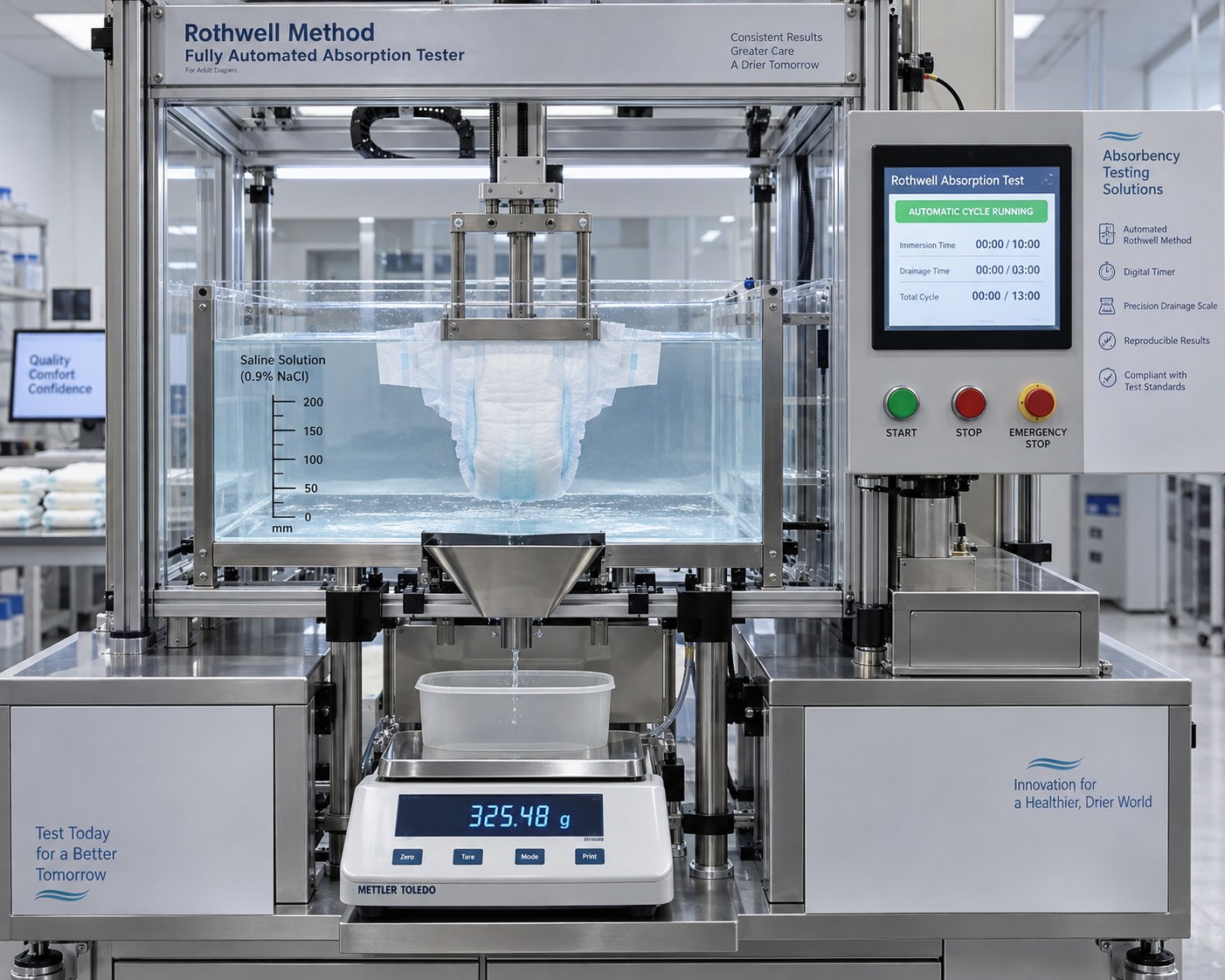
- Automated ISO 11948-1 Rothwell Workstation: Full diaper samples are mounted on robotic dipping racks and submerged into a temperature-regulated 0.9% physiological saline bath (23°C ± 1°C) for precisely 30 minutes. The robotic arm lifts the saturated sample, suspends it vertically for precisely 30 seconds to drain unbound surface liquid, and transfers it onto an automated Shimadzu analytical balance. Total Absorbency Capacity (TAC) is calculated automatically and uploaded directly to our laboratory information management system (LIMS), eliminating manual transcription errors.
- Automated Lister Strike-Through Tester: Utilizing Textest electronic strike-through instruments, an 80 ml bolus of test fluid is discharged through a precision conductive orifice block onto the diaper topsheet. The exact millisecond the fluid touches the top electrode, an electronic timer initiates, stopping automatically the instant the fluid penetrates the nonwoven and breaks the electrical contact.
The automated Rothwell testing system also integrates multi-channel electronic temperature sensors and salinity refractometers that verify test bath composition in real time. Because saline temperature and salt concentration directly affect superabsorbent polymer osmotic pressure and swelling kinetics, maintaining 0.90% ± 0.01% NaCl at precisely 23.0°C guarantees that test results reflect true clinical physiological conditions. The vertical drip rack utilizes calibrated optical droplet counters to record the exact liquid runoff rate, ensuring that samples are drained uniformly.
For strike-through testing, our laboratory utilizes a specialized multi-dose automated fluid delivery pump. In clinical usage, an incontinent patient does not discharge fluid only once; urinary incontinence involves repeated insults occurring over several hours. Our automated testing sequence discharges four successive 100 ml fluid insults at 15-minute intervals, measuring strike-through time across repeated insults. While lower-tier commercial diapers show dramatic strike-through slowdown on the third and fourth insults (exceeding 8 to 12 seconds), Shenghongda’s products maintain strike-through times under 2.2 seconds even on the fourth insult, validating the open-pore resilience of our through-air bonded ADL.
Shenghongda’s products consistently achieve strike-through times under 1.5 seconds, proving that our through-air bonded Acquisition Distribution Layer (ADL) instantly transmits fluid downward without surface pooling.
4. Mechanical Tensile Profiling & 180° Peel Adhesion on Shimadzu Dual-Column Testers
A diaper that exhibits excellent absorbency is functionally useless if its mechanical fastenings fail during clinical application. In healthcare nursing environments, bedridden patients frequently toss and turn, placing severe multi-directional shear and tensile stresses upon side fastening tabs, frontal landing zones, and waist elastics. If a fastening tab snaps or loses adhesive grip when a nurse adjusts the brief, the diaper must be discarded, wasting medical supplies and disrupting patient care.
To guarantee mechanical reliability, Shenghongda’s physical testing laboratory operates computerized dual-column universal testing machines from Shimadzu Corporation running under ASTM D882, ASTM D1876, and EDANA NWSP 110.4 protocols. The testing instruments evaluate 180-degree peel strength and dynamic shear resistance of side fastening tapes, mechanical hook-and-loop landing zones, and Lycra elastic strand attachments. High-speed load cells record force-elongation curves at 500 data points per second, confirming that refastenable hook tabs retain peel strength exceeding 3.8 N/25mm width even after five consecutive opening and re-closing cycles, guaranteeing reliable bedside refastening without tearing nonwoven chassis materials.
Standing leak barrier cuffs undergo automated hydrostatic pressure head testing conforming to ISO 1420. Multi-layer SMS hydrophobic nonwovens are subjected to an escalating column of pressurized water; our specifications demand that standing cuffs withstand a water column pressure exceeding 220 mm H₂O before any micro-droplet penetration occurs, ensuring complete barrier security against sudden high-volume urinary insults.
| Physical & Hydraulic Performance Metric | Standard Commercial Competitor | Shenghongda CNAS Verified Benchmark | Governing Standard | Clinical Sourcing Advantage |
|---|---|---|---|---|
| Total Absorbency (Size L Adult Brief) | 1,800 - 2,200 ml (Theoretical free-swell) | 3,200 - 3,500 ml (Verified Rothwell) | ISO 11948-1 | Guarantees overnight protection; reduces nursing changes |
| Surface Rewet Under 0.5 psi Pressure | 0.45 - 0.85 grams (Moist skin contact) | < 0.05 grams (Clinically dry skin) | EDANA NWSP 070.1.R2 | Eliminates skin maceration and prevents hospital IAD |
| Initial Liquid Strike-Through Time | 2.8 - 4.5 seconds (Surface pooling) | < 1.5 seconds (Instant penetration) | EDANA NWSP 070.4 | Zero lateral runoff during sudden high-volume surges |
| Mechanical Hook Tape Peel (Cycle 5) | 1.2 - 2.0 N/25mm (Tears or detaches) | > 3.8 N/25mm (Secure refastening) | ASTM D1876 | Allows repeated bedside inspection without diaper waste |
| Hydrophobic Leg Barrier Water Column | 140 - 160 mm H₂O | > 220 mm H₂O hydrostatic head | ISO 1420 | Absolute containment during heavy daytime walking |
| Microbial Bioburden Count (CFU/g) | 50 to 180 CFU/g (Variable safety) | < 20 CFU/g (Certified Medical Grade) | USP <61> / GB 15979 | Ten times cleaner than international regulatory limit |
5. Microbial Bioburden Surveillance & Pathogen Screening Under Pharmacopeial Protocols
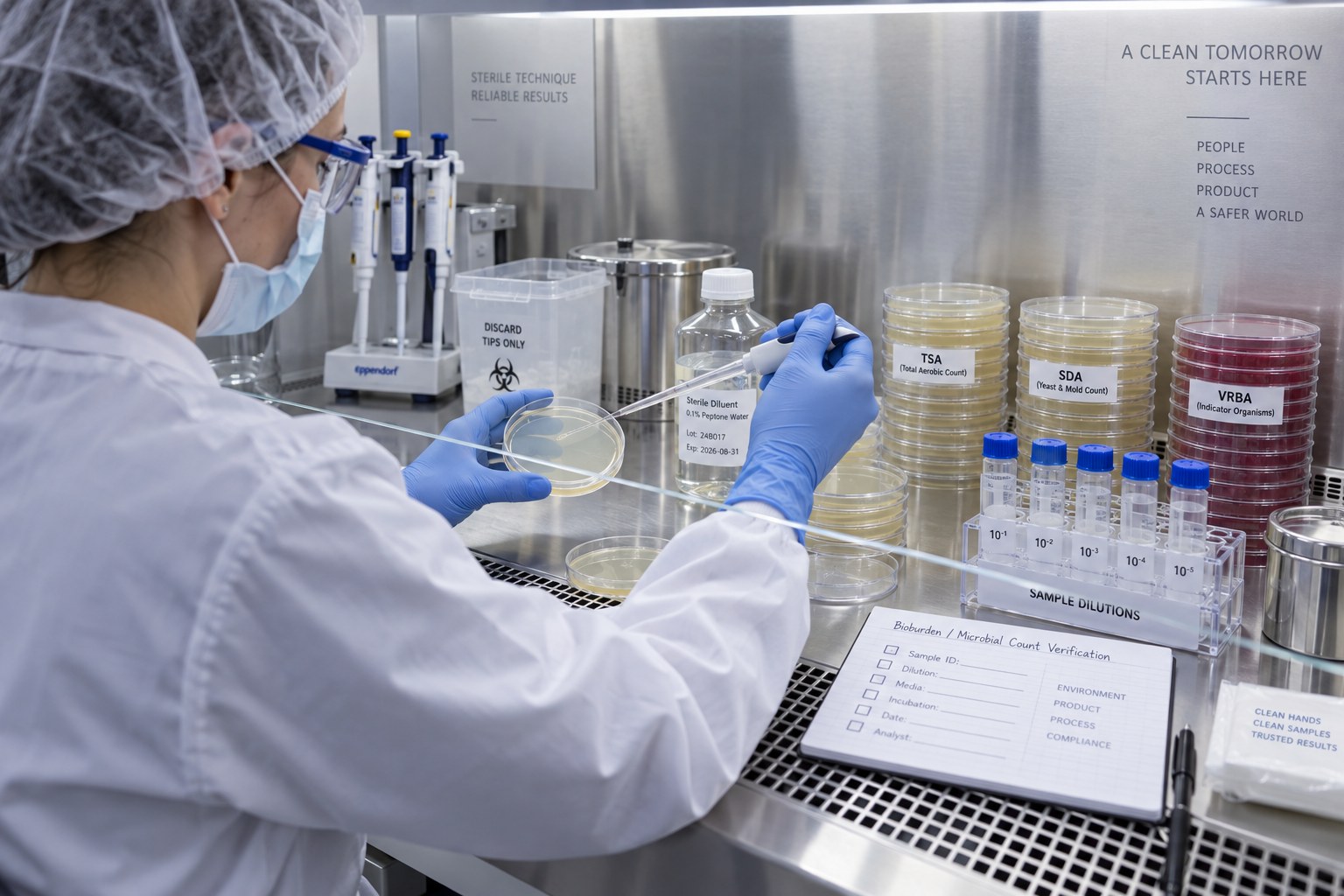
In addition to physical and chemical testing, the expanded testing center incorporates an accredited microbiology testing wing operating in full alignment with United States Pharmacopeia (USP) <61> (Microbial Examination of Nonsterile Products: Microbial Enumeration Tests) and USP <62> (Tests for Specified Microorganisms). Disposable hygiene articles maintain prolonged intimate contact with human skin and mucous membranes; in geriatric hospital wards, patients frequently have broken skin, surgical wounds, or weakened immune defenses. If hygiene products carry high microbial loads, opportunistic bacteria proliferate rapidly, causing severe cutaneous candidiasis, urinary tract infections (UTI), and bloodstream infections.
Our dedicated microbiological laboratory executes comprehensive multi-stage assays on every production lot:
- Total Aerobic Microbial Count (TAMC) & Yeast/Mold Count (TYMC): Samples are homogenized in buffered peptone water, filtered through 0.45-micron membrane filters, and incubated on soybean-casein digest agar at 35°C for 5 days. Shenghongda enforces an unyielding release ceiling of total bioburden strictly <20 CFU/g, far below the 200 CFU/g ceiling permitted by international consumer regulations.
- Selective Pathogen Screening: Samples undergo selective enrichment culturing to confirm the absolute absence of specified virulent pathogens: Staphylococcus aureus (using mannitol salt agar), Pseudomonas aeruginosa (using cetrimide agar), Escherichia coli (using MacConkey broth), and Candida albicans (using Sabouraud dextrose agar).
6. B2B Collaborative R&D & Benchmarking Services for Overseas Private Label Clients
An invaluable strategic benefit of Shenghongda’s expanded testing center is our Collaborative B2B R&D and Competitive Benchmarking Service. For international private-label brand owners, competing against dominant multinational consumer brands (such as Pampers, Huggies, TENA, and Depend) requires continuous formulation optimization and empirical marketing claims substantiation. Many emerging brands lack access to multimillion-dollar nonwovens laboratories and cannot scientifically verify whether their products match or exceed category leaders.
Shenghongda fills this technical gap for our OEM partners. When a client partners with us, our testing center provides complimentary competitive teardown benchmarking:
- Complete Competitor Reverse-Engineering: Clients send retail samples of leading competitor products in their local market. Our technicians deconstruct the product layer-by-layer, quantifying SAP loading, core density, fiber length, backsheet breathability (MVTR), and Rothwell absorbency.
- Formulation Optimization Modeling: Our polymer engineers simulate alternative material blends—such as optimizing Sumitomo SAP ratios or introducing through-air bonded ADL nonwovens—to achieve equivalent or superior clinical dryness while lowering raw material costs by 8% to 15%.
- Certified Laboratory Test Dossiers for Marketing Claims: We generate authenticated, CNAS-stamped test reports certifying claims such as "12-Hour Overnight Dryness," "Proven <0.05g Rewet," and "Dermatologically Tested Hypoallergenic," providing our brand partners with unassailable marketing ammunition for retail buyer presentations.
7. Quality Assurance Roadmap: How to Review and Audit Shenghongda's Testing Protocols
Shenghongda believes that absolute transparency is the cornerstone of enduring international manufacturing partnerships. We invite prospective brand owners, hospital procurement syndicates, and third-party inspection agencies to audit our testing center and review our metrological quality controls:
- Pre-Shipment Certificate of Analysis (COA) Verification: Every production lot manufactured at Shenghongda is accompanied by an authenticated COA detailing tested Rothwell capacity, strike-through speed, surface rewet, tensile strength, and bioburden counts, cross-referenced with production run timestamps.
- Third-Party Witness Testing Support: We routinely host third-party testing inspectors from SGS, Intertek, TÜV, and Bureau Veritas at our testing center, providing them with full access to our instrumentation and calibration records to witness pre-shipment compliance testing.
- Standard Sample Dispatch for Independent Validation: Prospective B2B buyers can request specialized testing verification kits containing production diaper samples, raw material swatches, and certified test reports to conduct independent comparative testing in their domestic accredited laboratories.
In addition to standard nonwoven testing, Shenghongda’s CNAS testing center conducts advanced polymer degradation and aging simulations under accelerated climatic conditions. Absorbent hygiene articles stored in tropical warehouse environments—such as Latin America, Southeast Asia, or the Middle East—can experience prolonged exposure to elevated temperatures (40°C to 50°C) and high humidity (80% to 90% RH). In our programmable environmental test chambers (Binder GmbH), production samples are subjected to 12-week accelerated aging cycles conforming to ASTM F1980 protocols. Technicians evaluate hot-melt adhesive elasticity, backsheet film tear resistance, and SAP absorbency under load (AUL) at regular intervals, confirming a validated shelf life of 36 months without performance degradation.
Furthermore, our laboratory operates high-speed digital microscopy workstations with automated image-analysis software. Nonwoven fiber orientation, thermal bonding point integrity, and SAP particle dispersion are evaluated at up to 1,000x magnification. Cross-sectional micro-tomography verifies that bicomponent fibers in the Acquisition Distribution Layer (ADL) maintain 3D helical crimp geometry under mechanical pressure, ensuring that capillary fluid transport channels remain unblocked throughout repeated voiding cycles.
Our metrological commitment extends to ongoing digital data integrity conforming to FDA 21 CFR Part 11 and ISO/IEC 17025. All laboratory analytical workstations are networked to a centralized Laboratory Information Management System (LIMS) featuring biometric operator authentication, immutable automated audit trails, and automatic electronic archiving. Test certificates generated by the system are cryptographically hashed and digitally signed, providing international healthcare authorities with unassailable proof of data authenticity.
In addition, Shenghongda’s testing center participates in annual international inter-laboratory comparisons under the auspices of EDANA and ASTM International committee D13. In these blind round-robin trials, identical nonwoven specimens are tested simultaneously across 25 accredited laboratories worldwide. Shenghongda consistently achieves Z-scores within |Z| <= 0.3 across fluid absorption, tensile elongation, and strike-through time, validating our laboratory's absolute metrological accuracy on the world stage.
Quanzhou Shenghongda Hygiene Products Co., Ltd. invites international personal care executives and clinical procurement directors to contact our testing center to request technical consultations, benchmark regional samples, and discover how our CNAS-accredited laboratory drives zero-defect manufacturing excellence.