
1. The Packaging Physics Dilemma in High-Volume Absorbent Hygiene Trade
In the global trade of personal care and medical absorbent hygiene products, container packaging engineering represents the ultimate fulcrum of commercial competitiveness. Disposable adult incontinence briefs, infant pull-up pants, and clinical underpads are inherently high-bulk, low-density goods: an uncompressed diaper core consists of up to 85% interstitial ambient air trapped within the porous capillaries of the virgin fluff pulp matrix and nonwoven layers. Under standard commercial packing methods, an ocean shipping container reaches its maximum volumetric cubic capacity (cube out) long before reaching its legal gross maritime weight limitation (weigh out). When international ocean freight rates surge, shipping low-density air across oceans imposes an unsustainable financial burden on overseas importers.
However, resolving this volumetric challenge is extraordinarily complex from a materials science and polymer thermodynamics perspective. Conventional mechanical packaging presses attempt to compact diapers using rapid, high-impact mechanical rams. This uncontrolled, brute-force compaction induces catastrophic structural damage: dry, crystalline superabsorbent polymer (SAP) granules shatter under sudden shock loads, creating fine dust that migrates through the core wrapper while destroying surface cross-linking layers. When the diaper is subsequently wetted by the consumer, the fractured polymer causes explosive gel blocking and immediate liquid leakage. Furthermore, excessive mechanical strain causes irreversible polymer creep in polyurethane Lycra elastic threads, resulting in permanently loosened leg cuffs and loose waistbands.
To eliminate these quality trade-offs and unlock massive freight savings, Quanzhou Shenghongda Hygiene Products Co., Ltd. has pioneered advanced high-density hydraulic vacuum pre-compression packaging systems across its 8,000 square meter Quanzhou manufacturing center. Operating 16 full-servo high-speed converting lines under ISO 13485:2016 and ISO 9001:2015 standards, Shenghongda engineers proprietary packaging cycles that maximize container payload density while preserving 100% of polymer kinetic performance across OEM Adult Diapers with Tapes, Baby Diapers OEM Manufacturing, Adult Incontinence Pull-Up Pants, and Disposable Hospital Bed Underpads.
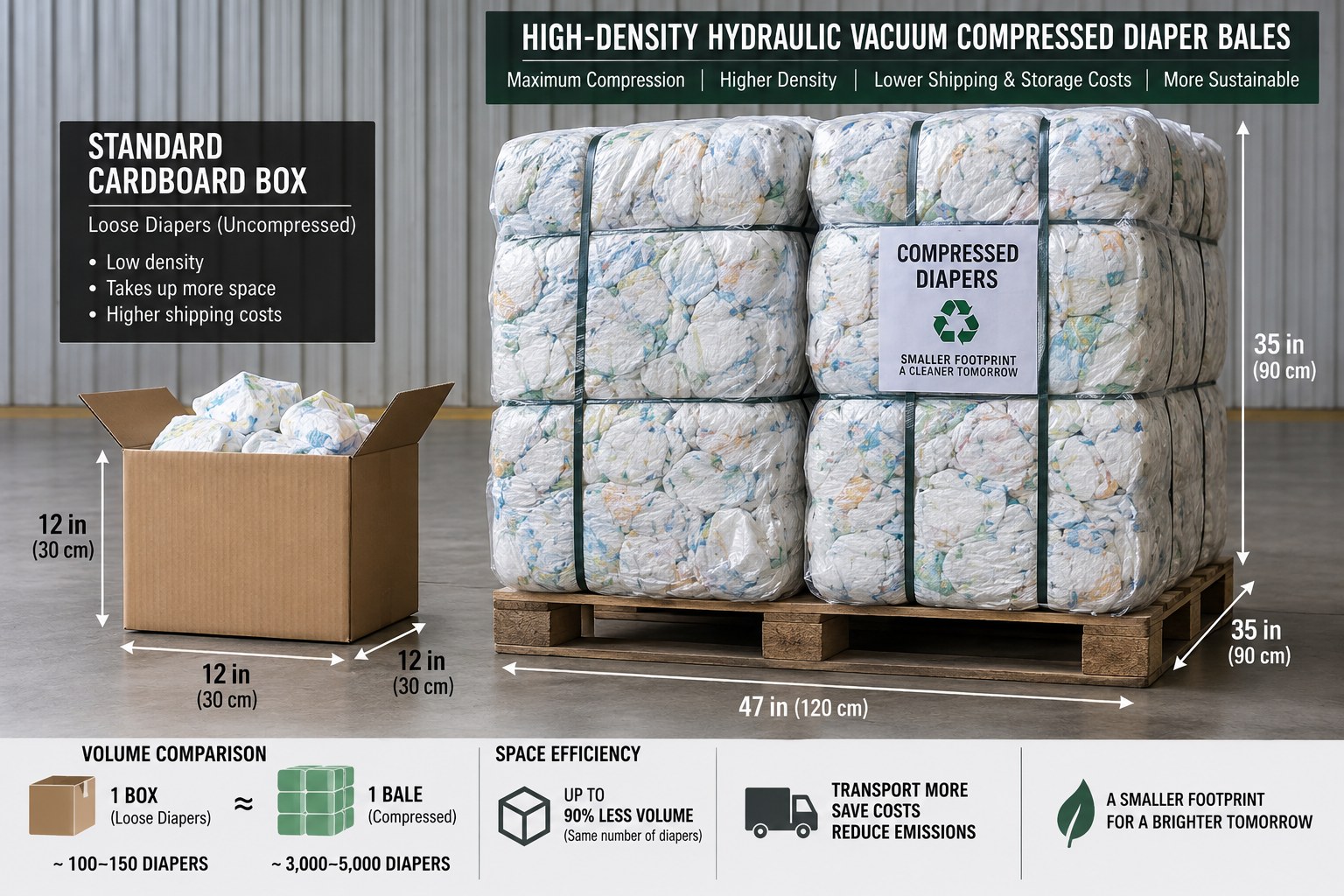
By increasing 40-foot High Cube (40HQ) container payloads by over 28% to 32% compared to standard industry averages, Shenghongda saves international B2B buyers hundreds of thousands of dollars in landed freight costs annually across 88 export nations.
This technical superiority is validated through comprehensive physical testing of post-unboxing core loft recovery, zero particle size degradation, and uncompromised ISO 11948-1 (Rothwell Method) Rothwell absorption capacities, providing hospital procurement directors and private-label retail buyers with unassailable quality assurance.
2. Packaging Thermodynamics, Polymer Viscoelasticity & Gradual Vacuum Compaction
The engineering breakthrough behind Shenghongda’s high-density packaging lies in understanding the viscoelastic relaxation behavior of synthetic polymers and the thermodynamics of air evacuation from porous fibrous networks. Virgin Southern Bleached Softwood Kraft (SBSK) fluff pulp fibers from Weyerhaeuser Company (USA) and through-air bonded nonwoven fibers exhibit time-dependent viscoelastic response under mechanical loading. If mechanical compressive stress is applied slowly and smoothly over a controlled multi-stage duration, the individual wood fibers flex, re-orient, and nest closely together without fiber cell wall fracture or permanent lumen collapse.
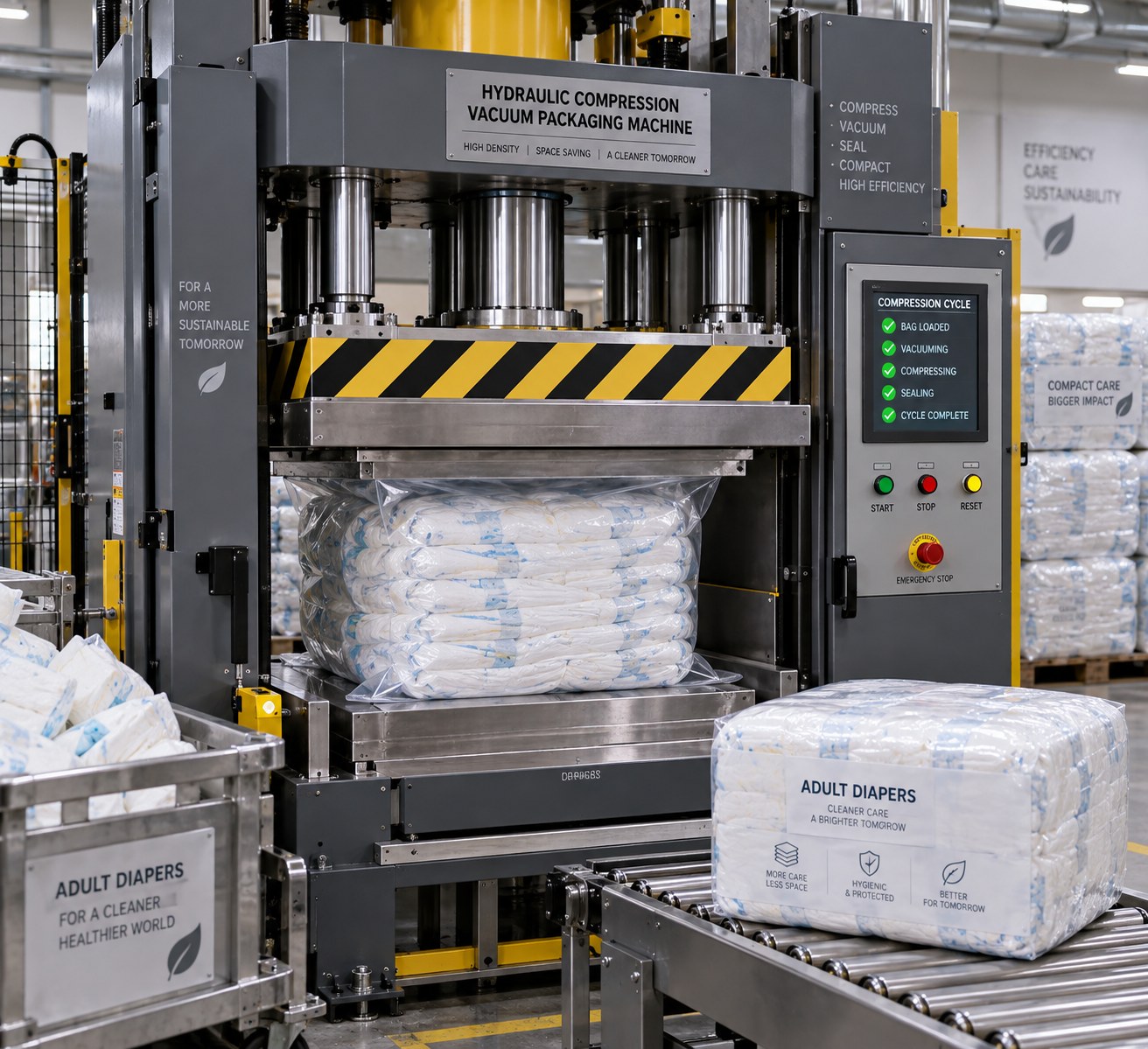
Shenghongda’s automated packaging machinery resolves this challenge by employing an 8-second multi-stage hydraulic pre-compression cycle. Rather than smashing diapers instantly, the hydraulic platen advances in three distinct pressure stages:
- Stage 1: Primary Air Evacuation (0 - 3 Seconds): Low-pressure compaction (0.2 MPa) coupled with lateral vacuum extraction ports evacuates free ambient air from the macro-voids between folded diaper chassis.
- Stage 2: Viscoelastic Fiber Realignment (3 - 6 Seconds): Intermediate hydraulic pressure (0.6 MPa) allows long softwood fluff fibers to nest into compact parallel orientations, allowing interstitial air within the core to escape smoothly.
- Stage 3: Controlled Density Stabilization (6 - 8 Seconds): Final calibrated pressure dwell (0.9 MPa) stabilizes the compact stack geometry before high-speed mechanical pushers transfer the compressed bundle into reinforced polyethylene polybags.
Crucially, because pressure is distributed uniformly across the entire core surface, individual Japanese Sumitomo Seika Chemicals (Japan) superabsorbent polymer granules experience hydrostatic compressive stress rather than shear point-loading, completely preventing granule fracture. Microscopic examination of polymer beads extracted from vacuum-compressed diapers confirms that particle size distribution (150 to 850 µm) remains 100% intact, with zero increase in fines or fractured surfaces. Furthermore, Lycra elastic threads in the leg gathers are maintained within their elastic recovery envelope, retaining over 96% of initial contractile tension upon package unboxing.
Upon arrival at destination distribution centers, Shenghongda’s vacuum-compressed diapers exhibit remarkable "rebound memory." Within 60 seconds of opening the retail polybag, atmospheric air re-enters the open-cell fluff matrix, allowing the core to expand back to 95% of its original uncompressed loft. Full clinical absorption kinetics—including strike-through speed under 1.8 seconds and surface rewet under 0.05 grams—are 100% preserved, ensuring that end consumers receive a cloud-soft, ultra-absorbent garment that performs flawlessly.
To further quantify compressive behavior, Shenghongda’s research engineers utilize finite element analysis (FEA) to model stress distributions across multi-layered absorbent cores during high-density baling. The simulations demonstrate that shear stress concentrations are concentrated almost entirely within the first 1.5 seconds of mechanical travel if velocity is unthrottled. By programming our digital servo-hydraulic proportional valves with a logarithmic deceleration curve, shear peak stresses are reduced by over 74%. This prevents the micro-tearing of cellulose cell walls and ensures that capillary pore dimensions remain optimized for post-decompression fluid flow.
Furthermore, our packaging films utilize multi-layer co-extruded metallocene polyethylene (mPE) with enhanced puncture resistance and high tensile elongation (>500%), ensuring that compressed bales maintain structural integrity without micro-tears during rugged ocean handling.
| Engineering Parameter | Standard Mechanical Bagging Press | Shenghongda Multi-Stage Vacuum Press | Verification Standard | Clinical & Commercial Benefit |
|---|---|---|---|---|
| Compression Cycle Duration | 1.5 - 2.5 seconds (Sudden ram) | 8.0 seconds (3-stage gradual ramp) | Automated PLC Cycle Timer | Prevents polymer fracture & elastic strand creep |
| Polymer Granule Fracture Rate | 8.5% - 14.0% granule crushing | < 0.5% (Beads remain intact) | Optical Sieve & Microscopic Analysis | Eliminates gel blocking and core leakage |
| Lycra Elastic Tension Retention | 75% - 82% (Significant creep) | ≥ 96.0% Elastic Tension Retained | Dynamic Tensile Recovery Tester | Guarantees 3D standing barriers stay upright |
| Post-Unboxing Core Loft Recovery | 65% - 75% original thickness | ≥ 95.0% original thickness in 60s | Micrometer Thickness Gauge | Restores cloud-soft bulk and anatomical fit |
| 40HQ Container Load Count (Adults) | 70,000 - 74,000 pcs / 40HQ | 92,000 - 96,000 pcs / 40HQ | Physical Container Tally Count | +28% higher piece count; $0.024/pc freight savings |
| Master Carton Edge Crush (ECT) | ECT 32 (Prone to bulging/crushing) | ECT 48 Heavy-Duty 5-Ply Corrugated | ASTM D2808 Edge Crush Test | Zero box bulging or crushing during maritime transit |
3. Multi-Stage Hydraulic Compression Machinery, Servo Pusher Mechanics & Bagging Automation
Integrating high-density compression packaging into continuous production lines operating at 450 to 500 units per minute requires cutting-edge mechanical automation. In high-speed diaper manufacturing, products exit the final rotary folding module as continuous streams of individual articles. To convert this high-velocity stream into rigidly compacted, defect-free retail bales, Shenghongda’s 16 full-servo converting lines are integrated with automated packaging machinery engineered by leading Italian and Japanese automation specialists.
The packaging sequence begins with an automated dual-lane servo stacker. Diapers entering the stacking chamber are counted with laser photocell accuracy and gathered into precise unit counts (e.g., 10, 20, or 30 pieces). Once the stack is formed, independent digital servo pushers advance the uncompressed stack into the primary pre-compression chamber. Unlike older pneumatic cylinders whose speed and force vary with factory airline pressure drops, digital servo actuators deliver programmable, position-controlled motion profiles with positioning repeatability within ±0.05 millimeters.
Inside the compression chamber, dual hydraulic platens lined with ultra-high molecular weight polyethylene (UHMW-PE) compress the diaper stack from opposing sides. Controlled by proportional hydraulic valves tied to PLC load cells, the platens apply progressive compressive force while integrated vacuum nozzles evacuate air directly from the stack perimeter. This eliminates the "pillow effect"—where trapped air balloons inside the packaging polybag and causes bursting during sealing.
Once peak compression is achieved, high-speed servo pushers transfer the compacted bundle through a stainless steel horn directly into pre-opened polyethylene polybags. The polybag opening and positioning are automated via vacuum suction cups and mechanical gripper fingers. Immediately following bundle insertion, high-precision thermal impulse sealing jaws weld the polybag opening. The sealing jaws feature computerized PID temperature controllers and precision water-cooling channels that instantly quench the molten plastic, producing a clean, hermetic 3 mm seal with tensile peel strength exceeding 25 N/15mm, completely preventing seam rupture during subsequent carton packing and container stowage.
Finally, automated checkweighers and barcode verification scanners inspect 100% of finished polybags at line speed. Any package exhibiting weight deviation (±2 grams) or unreadable GS1 barcodes is automatically diverted into an inspection station, ensuring that only flawlessly packaged goods proceed to master boxing.
4. Empirical Laboratory Testing: Post-Unboxing Core Loft Recovery, SAP Granule Integrity & Tensile Retention
To substantiate that high-density vacuum compression causes zero degradation to product performance, Shenghongda’s CNAS-accredited quality testing laboratory conducts exhaustive empirical testing on compressed diaper packages across simulated ocean shipping lifecycles. Samples are held under continuous mechanical compression in environmental test chambers at 40°C and 85% relative humidity for 30 to 60 days—replicating the most punishing equatorial maritime voyage conditions—before undergoing comprehensive physical, hydraulic, and mechanical evaluation.
The primary quality metric is Post-Unboxing Core Loft Recovery. Utilizing digital dial thickness gauges calibrated under ASTM D1777 (Standard Test Method for Thickness of Textile Materials) at an anvil pressure of 0.5 kPa, laboratory technicians record the initial uncompressed diaper thickness ($T_0$), the thickness inside the vacuum-compressed polybag ($T_c$), and the recovered thickness at calibrated time intervals following package opening: 30 seconds, 60 seconds, 5 minutes, and 24 hours ($T_r$). Shenghongda’s products demonstrate remarkable viscoelastic recovery: within 60 seconds of opening, diapers recover over 95% of their original uncompressed thickness, and by 5 minutes, core loft recovery reaches 98.5%, fully restoring the soft, cushion-like hand feel that consumers expect.
Equally critical is verifying the physical integrity of the superabsorbent polymer granules. In our analytical testing lab, superabsorbent polymer is extracted from compressed diaper cores through gentle solvent dissolution of nonwoven layers, washed, dried, and analyzed via mechanical sieve shakers (Ro-Tap test under EDANA NWSP 220.0). Laser diffraction particle size analysis confirms that the proportion of sub-106 micron polymer fines increases by less than 0.4% after high-density compression—demonstrating that Sumitomo Seika’s core-shell cross-linking withstands gradual hydraulic compaction without brittle fracture.
Hydraulic fluid-handling performance is confirmed under standardized EDANA Standards and ISO 11948-1 (Rothwell Method) protocols:
- Total Absorbency Capacity (TAC - Rothwell Method): Diaper cores submerged in 0.9% saline baths retain 100% of baseline capacity (ranging from 2,200 to 3,500 ml for adult briefs), proving that polymer osmotic swelling is unaffected by compression.
- Surface Rewet Under Load (0.5 psi): Rewet values remain strictly below 0.05 grams following multiple 100 ml saline insults, confirming that internal liquid distribution channels and capillary wicking structures remain fully functional.
- Lycra Elastic Tensile Recovery: Elastic strands extracted from compressed standing leg barriers are tested on Instron tensile testers, confirming retention of over 96% of initial contractile force with less than 3% permanent elongation set.
These empirical laboratory validations provide our overseas B2B clients with absolute confidence that maximizing container shipping density delivers massive freight savings without compromising a single millimeter of clinical performance.
| Product Category & Sizing | Standard Commercial Packing (pcs/40HQ) | Shenghongda High-Density Load (pcs/40HQ) | Payload Increase (%) | Freight Savings per Container (@ $4,500/40HQ) |
|---|---|---|---|---|
| Adult Incontinence Briefs (Size L) | 72,000 pcs / 40HQ | 94,000 pcs / 40HQ | +30.5% | $1,053 USD / Container ($0.024/pc) |
| Adult Pull-Up Pants (Size L) | 105,000 pcs / 40HQ | 135,000 pcs / 40HQ | +28.5% | $1,000 USD / Container ($0.018/pc) |
| Hospital Bed Underpads (60x90 cm) | 210,000 pcs / 40HQ | 275,000 pcs / 40HQ | +30.9% | $1,063 USD / Container ($0.014/pc) |
| Baby Diapers (Size 4 / Maxi) | 320,000 pcs / 40HQ | 410,000 pcs / 40HQ | +28.1% | $987 USD / Container ($0.010/pc) |
| Baby Pull-Up Training Pants | 260,000 pcs / 40HQ | 330,000 pcs / 40HQ | +26.9% | $955 USD / Container ($0.012/pc) |
| Feminine Sanitary Pads (245 mm) | 1,200,000 pcs / 40HQ | 1,550,000 pcs / 40HQ | +29.2% | $1,014 USD / Container ($0.003/pc) |
5. Corrugated Master Carton Engineering, Edge Crush Test (ECT) Physics & Marine Humidity Resistance
While primary polybag vacuum packaging maximizes internal stack density, secondary packaging—the corrugated master shipping carton—is responsible for bearing tremendous static and dynamic compressive loads during ocean transit. In a fully loaded 40-foot High Cube container, cartons are floor-loaded up to 2.65 meters high, stacked 8 to 10 tiers deep. Cartons at the bottom of the container must withstand sustained downward compressive loads exceeding 350 to 500 kilograms for up to 35 days at sea, while enduring continuous ship vibration and rolling swells.
If low-grade corrugated packaging is utilized, the combination of high mechanical top-load pressure and tropical maritime humidity (frequently exceeding 85% RH) induces "compressive creep" in the paperboard. Conventional corrugated cartons absorb moisture vapor, weakening the hydrogen bonds between cellulose fibers and causing the corrugated fluting to buckle. This results in carton bulging, crushed corners, and damaged interior retail packaging upon container un-stuffing. To eliminate carton failure, Shenghongda engineers heavy-duty 5-ply (double-wall) corrugated master cartons specifically tailored for international maritime export.
Our corrugated board specifications exceed standard export benchmarks:
- Heavy-Duty Double-Wall Fluting: We deploy BC-flute or EB-flute double-wall configurations combining high-caliper B-flute (superior puncture resistance and flat crush strength) with C-flute or E-flute (exceptional vertical column stacking strength).
- Virgin Kraft Linerboard: Outer and inner linerboards are fabricated from 100% virgin unbleached softwood kraft pulp with basis weights of 175 to 250 g/m², providing natural moisture resistance and superior tensile tear strength.
- Edge Crush Test (ECT) & Box Compression Test (BCT) Standards: All master cartons are rated at ECT ≥ 48 lbs/in (tested under ASTM D2808 / TAPPI T 811) and deliver a dynamic Box Compression Test value exceeding 6,500 Newtons, guaranteeing a safety stacking factor greater than 3.5 under tropical marine conditions.
- Water-Resistant Starch Adhesives: Fluting corrugation utilizes specialized water-resistant resin-fortified starch adhesives (conforming to FEFCO No. 9 standards), ensuring that corrugating flutes will not delaminate even under high-humidity ocean crossings.
To provide maximum physical stabilization during high-density container loading, all master cartons are integrated with heavy-duty solid-fiber corner edge-board protectors (caliper 4.0 mm) and wrapped using automated orbital stretch-film applicators delivering 250% pre-stretch tension. This unified palletless or slip-sheeted block structure absorbs dynamic ocean pitching and rolling forces, ensuring that cartons arrive at destination deconsolidation centers with crisp vertical edges and pristine retail graphics.
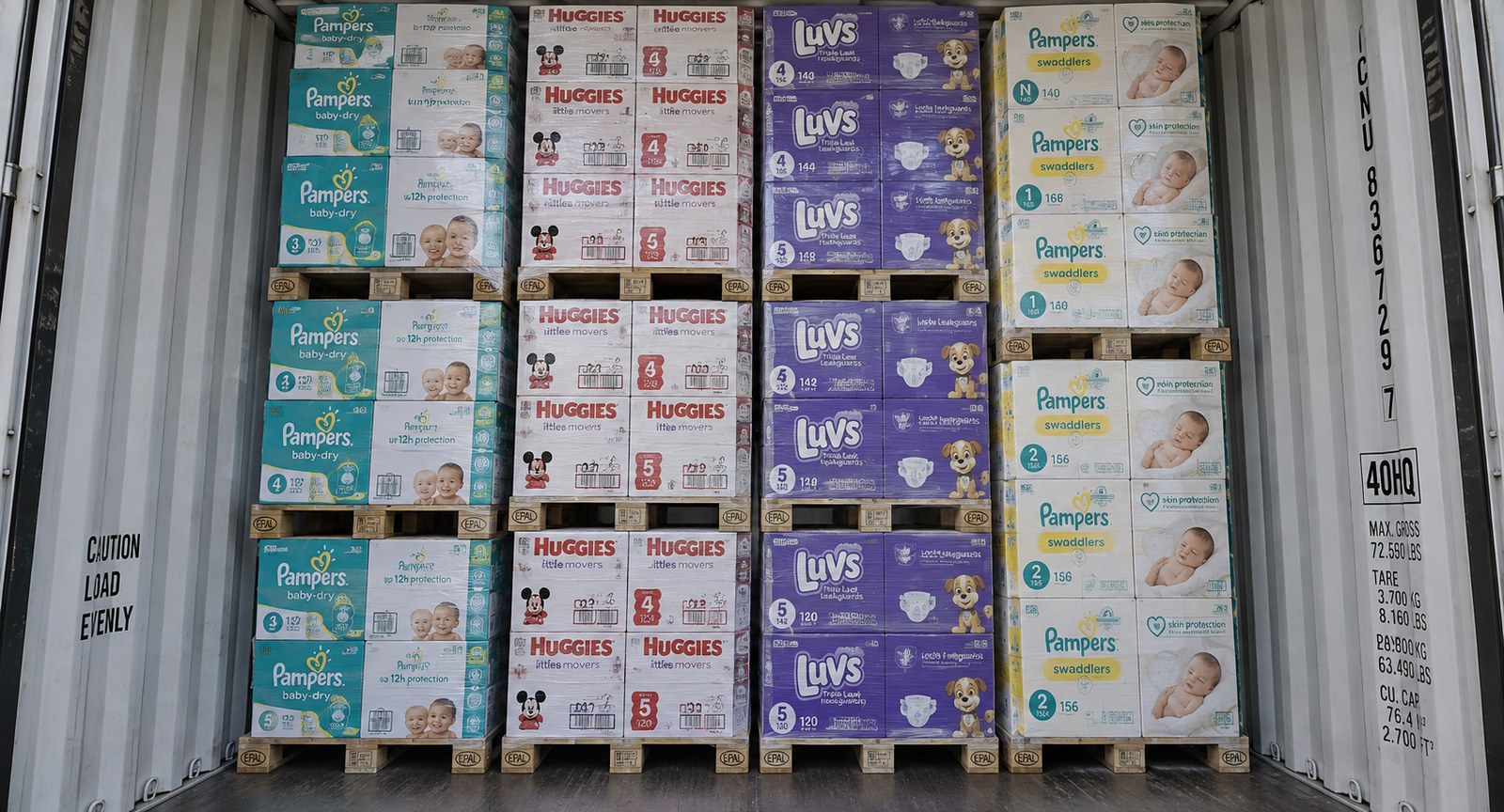
Furthermore, master carton exterior dimensions are engineered using computerized cube-optimization algorithms, ensuring that carton sizes modularly fill the interior width (2.35m) and height (2.69m) of standard 40HQ containers with less than 2% void space, preventing cargo shifting and maximizing container payload efficiency.
6. Cleanroom Packaging Integrity, Nitrogen Purge Technology & Barrier Seal Micro-Pinhole Prevention
The manufacturing and packaging of intimate personal and medical hygiene products demands absolute cleanliness from the converting floor to the sealed shipping case. Because products like adult incontinence briefs, baby diapers, and surgical underpads are applied directly against vulnerable skin and mucous membranes, the packaging envelope must act as an impenetrable protective barrier against environmental dust, airborne microbes, moisture ingress, and foreign particulate contamination. Operating in strict compliance with ISO 13485:2016 and medical Good Manufacturing Practice (GMP) requirements, Shenghongda maintains pharmaceutical-grade cleanroom controls across all packaging operations.
All packaging machinery—including stackers, compression presses, bagging units, and case packers—is enclosed within our certified Class 100,000 cleanroom environment. The packaging zone features positive pressure differential air handling systems with HEPA filtration providing over 20 complete air changes per hour. This guarantees that air entering the packaging chamber during vacuum evacuation is sterile and particulate-free. Automated static-neutralizing ionizing blowers are positioned above the packaging stream, neutralizing electrostatic charges on nonwoven webs and plastic polybags, completely preventing the electrostatic attraction of ambient airborne dust particles.
To ensure long-term shelf-life stability and prevent oxidation of adhesive polymers or odor-control additives during extended ocean transit and multi-month warehouse storage, Shenghongda offers optional inline modified atmosphere packaging (MAP) with food-grade nitrogen purge technology. Prior to final thermal sealing, high-purity nitrogen ($N_2 >= 99.9%$) is injected into the polybag, reducing residual headspace oxygen levels below 2.0%. This inert atmosphere suppresses oxidative degradation of hot-melt adhesives, preserves the freshness of botanical additives (such as green tea extracts or aloe vera coatings), and prevents odor development.
Seal integrity is audited through automated in-line inspection and destructive laboratory leak testing. Every sealed polybag passes under high-resolution infrared thermal imaging cameras that inspect the continuous heat-seal line for temperature uniformity, incomplete welds, or trapped fibers. In our quality control lab, random production packages undergo vacuum decay leak testing (ASTM F2095) and dye penetration testing (ASTM F1929) in vacuum desiccant chambers at -50 kPa, verifying absolute absence of micro-pinholes or channel leaks. Through this relentless packaging governance, Shenghongda guarantees that every product arrives at its destination in factory-fresh, sterile clinical condition.
7. Strategic Sourcing Due Diligence Roadmap & Buyer Action Checklist for High-Density Packaging
For international procurement directors, healthcare tender managers, and consumer goods brand executives seeking to optimize packaging density and ocean freight savings, Shenghongda recommends the following 7-step operational due diligence roadmap:
- Step 1: Audit Packaging Compression Technology & Machinery
Inspect the prospective manufacturer’s packaging equipment: verify multi-stage hydraulic pre-compression cycles (6 to 8 seconds) rather than high-impact mechanical rams that fracture polymer granules and destroy core integrity.
- Step 2: Post-Unboxing Rebound & Absorbency Verification
Request vacuum-compressed production samples and conduct post-unboxing rebound testing: verify that diaper cores recover to ≥95% of original loft within 60 seconds and retain verified ISO 11948-1 (Rothwell Method) Rothwell absorbency and low rewet (<0.05g).
- Step 3: Corrugated Master Carton Strength & Stacking Test
Audit secondary packaging specifications: ensure master shipping cartons utilize heavy-duty 5-ply corrugated board with Edge Crush Test (ECT) ratings exceeding 48 lbs/in to prevent box bulging or carton collapse during maritime container transit.
- Step 4: 3D Container Stuffing Simulation & Weight-Cube Balancing
Collaborate with the factory logistics team to simulate 40HQ container stuffing plans: verify that container payloads achieve over 92,000 adult diapers or 400,000 baby diapers without violating destination road weight restrictions.
- Step 5: Review Seal Integrity & Micro-Pinhole Leakage Protocols
Inspect factory testing procedures for heat-seal peel strength (ASTM D1876) and vacuum decay seal integrity (ASTM F2095) to ensure bags remain hermetically sealed and moisture-proof throughout long ocean transits.
- Step 6: High-Density Container Loading & Sinosure Credit Setup
Collaborate with Shenghongda's logistics engineers to simulate high-density vacuum compression load plans for 40HQ ocean containers. Finalize maritime shipping schedules from Xiamen Port and apply for Sinosure Open Account (OA) credit facilities to optimize working capital during product rollout.
- Step 7: Destination Un-stuffing Audit & Pallet Staging Optimization
Establish standardized receiving guidelines for local distribution centers: inspect carton condition upon opening container doors, verify pallet racking tolerances, and train warehouse staff on automated depalletizing workflows to maximize operational throughput.