
1. The Global Landscape of Public Healthcare Incontinence Tenders
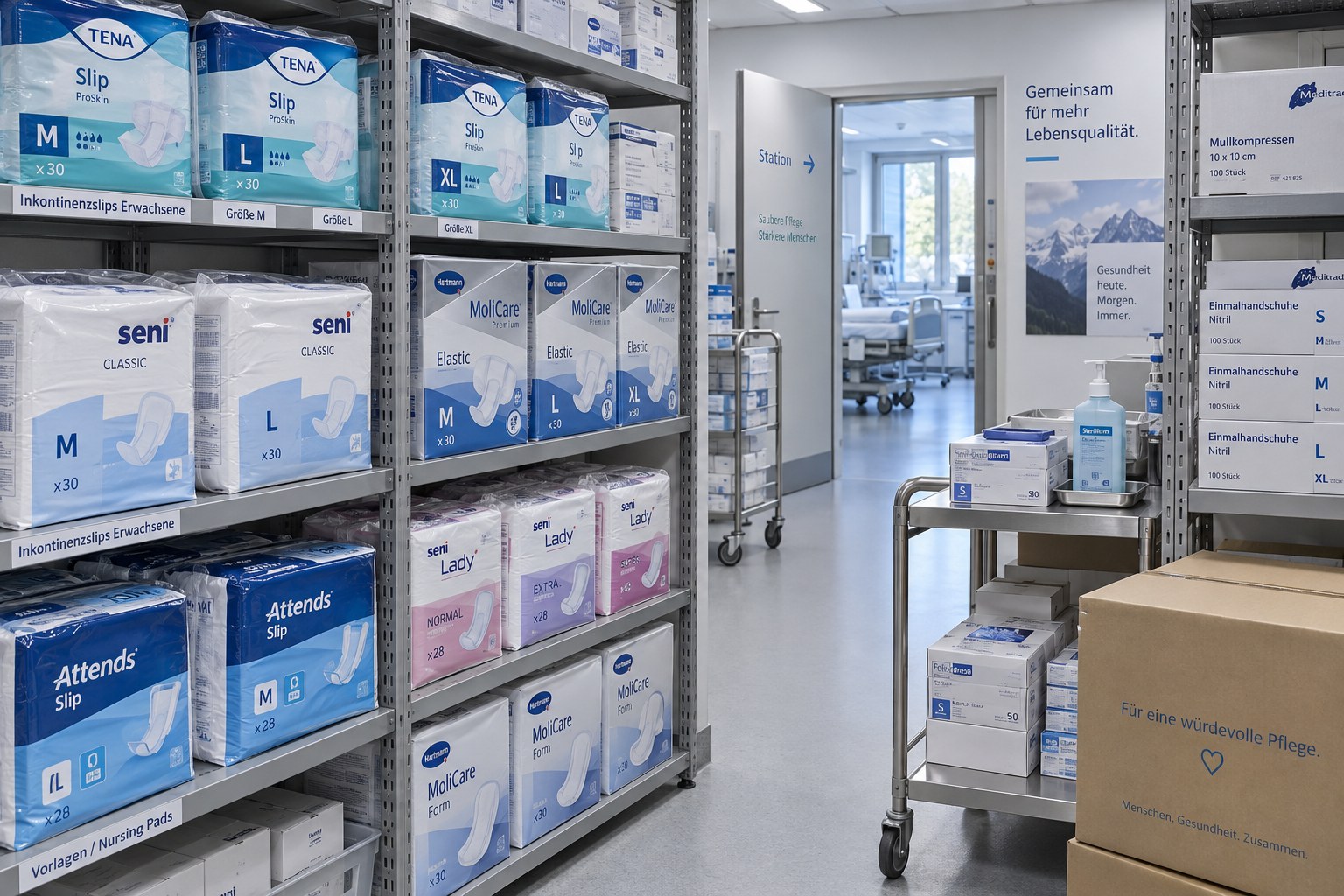
Public healthcare systems and institutional nursing syndicates worldwide—including the National Health Service (NHS) in the United Kingdom, SERMAS in Spain, the Assistance Publique - Hôpitaux de Paris (AP-HP) in France, IMSS in Mexico, and the Department of Veterans Affairs (VA) in the United States—operate under immense fiscal and clinical scrutiny. Within acute post-operative wards, intensive care units, spinal injury centers, and long-term geriatric nursing facilities, heavy urinary and fecal incontinence represents a daily clinical challenge affecting millions of bedridden patients. To manage these vulnerable patient populations, public hospital procurement boards issue massive multi-year tenders representing hundreds of millions of units annually.
Historically, hospital procurement departments often evaluated diaper tenders predominantly through the lens of lowest initial unit acquisition price. However, contemporary health economics and clinical governance have completely discredited this approach. In clinical practice, procuring cheap, low-grade incontinence briefs with poor core integrity, low retention capacity, and non-breathable plastic backsheets directly causes severe secondary complications, most notably Incontinence-Associated Dermatitis (IAD), moisture lesions, and Stage I-IV pressure ulcers. Treating a single advanced hospital-acquired pressure ulcer costs healthcare systems between $8,000 and $25,000 USD in specialized wound-care dressings, extended length of stay, and intensive nursing interventions—vastly exceeding any marginal savings achieved by purchasing sub-standard disposable briefs.
Consequently, international hospital tender committees have established uncompromising, highly technical pre-qualification standards. To qualify for national healthcare contracts, manufacturers must submit verified laboratory test certificates substantiating total absorption capacity under ISO 11948-1 (Rothwell Method) (Rothwell Method), surface dryness under mechanical load in accordance with EDANA Standards NWSP standards, standing barrier cuff hydrostatic resistance, and microbiological bioburden controls under ISO 13485:2016 and European CE MDR (EU 2017/745). Operating 16 high-speed full-servo converting lines in Quanzhou, China, Quanzhou Shenghongda Hygiene Products Co., Ltd. specializes in engineering clinical-grade incontinence products that satisfy and exceed these institutional benchmarks across OEM Adult Diapers with Tapes, Adult Incontinence Pull-Up Pants, and Disposable Hospital Bed Underpads.
By providing verified third-party laboratory dossiers, batch-level traceability, and guaranteed container delivery schedules from our deep-water logistics hubs at Xiamen and Quanzhou ports, Shenghongda serves as the primary manufacturing engine for hospital supply contractors bidding on major public tenders across more than 88 countries worldwide.
2. Clinical Hydraulic Engineering: Dual-Core Architecture, Heavy Insult Kinetics & IAD Prevention
Clinical heavy incontinence differs fundamentally from ambulatory retail incontinence. In bedridden hospital patients, urinary discharge does not occur in gradual, minor droplets; it occurs in heavy, high-velocity voids often exceeding 200 ml to 300 ml released in fewer than 10 seconds. Furthermore, recumbent patients remain immobilized in supine or lateral positions for extended hours, exerting continuous localized hydrostatic pressure exceeding 0.5 psi to 0.8 psi (3.5 to 5.5 kPa) directly against the wetted absorbent core. Under these severe clinical conditions, standard single-core diapers suffer from rapid gel blocking and catastrophic peripheral leakage.
To withstand repeated heavy voids without leakage or moisture backflow, Shenghongda engineers a specialized dual-matrix absorbent core architecture. The upper "acquisition core" features a high concentration of untreated virgin Southern Bleached Softwood Kraft (SBSK) fluff pulp from American producer Weyerhaeuser Company (USA) (Golden Isles brand), blended with fast-absorbing, moderately cross-linked superabsorbent polymers (SAP). This upper layer acts as a rapid hydraulic capacitor, instantly capturing the high-velocity fluid insult and diffusing it longitudinally across an engineered 3D capillary nonwoven envelope. Beneath this sits the high-density "storage core," containing specialized Japanese Sumitomo Seika Chemicals (Japan) Aqua Keep SA60 polymer beads with exceptionally high Absorbency Under Load (AUL ≥ 24 g/g at 0.7 psi) and Centrifugal Retention Capacity (CRC ≥ 32 g/g). These polymer granules lock liquid permanently into a cohesive hydrogel matrix, resisting mechanical expulsion even when a 100 kg patient is repositioned in bed.
Complementing the absorbent core is an engineered fluid-management topsheet system. Directly beneath an ultra-soft, micro-perforated hydrophilic nonwoven topsheet is a high-loft Acquisition Distribution Layer (ADL) manufactured from through-air bonded bicomponent (PE/PET) fibers with a basis weight of 45 to 60 g/m². This open-pore nonwoven layer provides a temporary physical holding reservoir that channels incoming surges downward into the core, achieving an initial strike-through time under 1.8 seconds. On the exterior chassis, Shenghongda applies breathable microporous polyethylene films laminated with spunbond polypropylene, delivering a Moisture Vapor Transmission Rate (MVTR) exceeding 3,500 g/m²/24h. This continuous microclimate ventilation allows warm moisture vapor to evaporate while retaining absolute liquid impermeability, maintaining an optimal acidic skin microclimate (pH 5.5) and mitigating the epidermal maceration that precipitates Incontinence-Associated Dermatitis.
To eliminate lateral leakage during lateral patient turning, Shenghongda’s hospital briefs incorporate continuous 3D standing leak barriers with a towering height of 38 to 45 mm. Fabricated from hydrophobic Spunbond-Meltblown-Spunbond (SMS) nonwoven fabric with a hydrostatic head resistance exceeding 220 mm H₂O, these barriers feature four individual strands of medical-grade Invista Lycra elastic positioned under progressive tension gradients. The elastic gathers conform anatomically to the inguinal folds, creating an impenetrable liquid dam that accommodates even the heaviest nighttime gushes without exerting excessive skin pressure or causing ischemic redness.
| Technical Parameter | Standard Commercial Threshold | Hospital Tender Minimum Spec | Shenghongda Verified Benchmark | Clinical Significance |
|---|---|---|---|---|
| Total Absorption Capacity (TAC) | 1,200 - 1,500 ml | ≥ 2,200 ml (Size L) | 2,850 - 3,500 ml (Verified Rothwell) | Provides 12-hour overnight security for severe incontinence |
| Surface Rewet Under Load (0.5 psi) | 0.50 - 1.20 grams | ≤ 0.20 grams | < 0.05 grams (EDANA NWSP 070.1.R2) | Prevents perineal skin maceration and hospital-acquired IAD |
| Initial Strike-Through Time | 3.0 - 5.0 seconds | ≤ 2.2 seconds | 1.6 - 1.8 seconds (Lister Method) | Eliminates surface liquid pooling during rapid urinary voids |
| Standing Barrier Cuff Height | 25 - 30 mm | ≥ 35 mm | 38 - 45 mm (4 Lycra strands) | Prevents catastrophic lateral leakage during patient turning |
| Chassis Breathability (MVTR) | Non-breathable PE (<800) | ≥ 2,500 g/m²/24h | ≥ 3,600 g/m²/24h (ASTM E96) | Controls skin microclimate temperature and humidity |
| Microbiological Cleanliness | < 200 CFU/g | ≤ 50 CFU/g | < 20 CFU/g (GB 15979 / USP <61>) | Eliminates secondary bacterial and fungal clinical infections |
3. Full-Servo Converting Machinery, Automated Vision Inspection & Inline Packaging
Manufacturing clinical-grade adult incontinence products at the massive volumes required by national healthcare tenders demands industrial automation of the highest order. Shenghongda’s Quanzhou converting facility houses 16 full-servo high-speed converting lines capable of producing over 1.2 billion units annually. For our medical-grade adult briefs and pull-up pants, production is anchored by state-of-the-art converting machinery from Japanese leader Zuiko Corporation and European manufacturer Fameccanica, operating at continuous design speeds of up to 450 units per minute.
Unlike semi-servo converting lines that rely on mechanical line-shafts, gear trains, and timing belts—which are inherently vulnerable to mechanical backlash, thermal expansion, and rotational vibration—Shenghongda’s converting lines utilize decentralized electronic servo drives directly coupled to every unwind stand, rotary cutting die, embossing cylinder, and vacuum conveyor. Centralized high-speed motion controllers communicating over real-time industrial Ethernet (EtherCAT) continuously synchronize the speeds and angular positions of more than 40 independent servo axes. This allows our mechanical engineers to fine-tune web tensions down to 0.1 N/m, entirely eliminating web wrinkles, material necking, or core dislocation during high-speed operation.
Quality assurance on our hospital production lines is 100% automated via continuous inline machine vision surveillance. Multi-camera Cognex high-resolution CCD vision systems equipped with pulsed LED strobe illumination capture micro-second images of every single diaper unit traveling down the conveyor belt. Dedicated optical algorithms analyze each product in real-time, verifying critical clinical parameters including:
- Absorbent Core Positioning: Optical inspection verifies the longitudinal and lateral alignment of the dual-core pad relative to the backsheet within an exacting tolerance of ±1.0 mm.
- Foreign Particulate Contamination: Multi-spectral cameras detect microscopic foreign fibers, dark specks, or insect contamination down to 0.2 mm² surface area.
- Adhesive Integrity: Infrared sensors verify hot-melt adhesive spray uniformity on elastic leg gathers, ensuring zero glue bleed-through to skin-contact zones.
- Elastic Gather Tension: High-speed optical tracking confirms that all four Lycra strands in each standing barrier cuff are continuous, unbroken, and under equal tension.
- Fastening System Symmetry: Optical sensors confirm that multi-refastenable polypropylene hook tabs and printed frontal landing zones are aligned with absolute mechanical symmetry.
4. Laboratory Testing Protocols, CNAS Validation & International Standards Verification
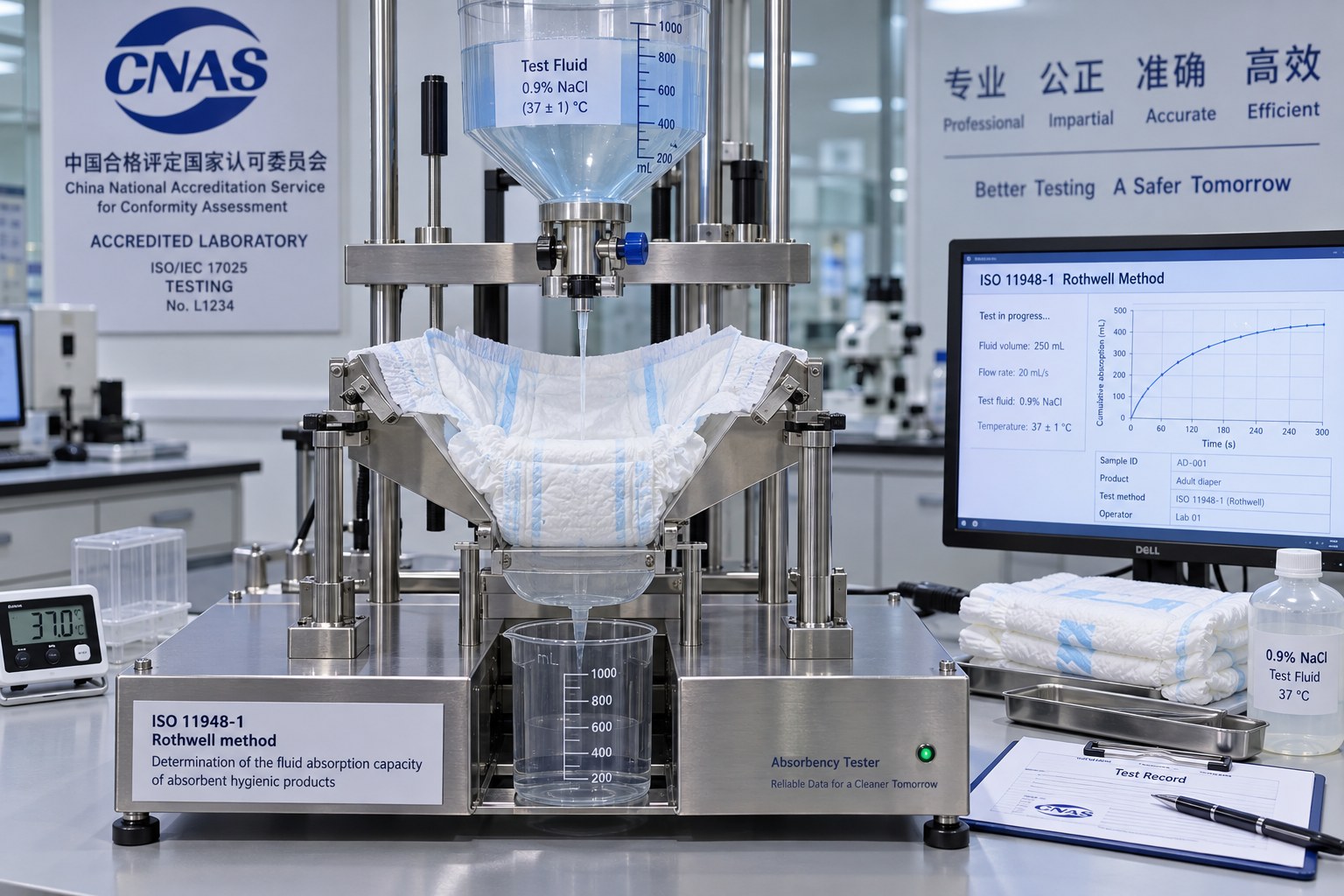
Substantiating technical claims for hospital tenders demands rigorous empirical validation in an accredited laboratory environment. Operating in strict accordance with CNAS National Accreditation and ISO/IEC 17025 Accredited standards, Shenghongda’s dedicated Testing and Analytical Center conducts continuous batch-by-batch physical, chemical, and microbiological testing across all hospital-grade production runs.
The definitive international gold standard for assessing adult incontinence capacity is the ISO 11948-1 (Rothwell Method) Rothwell Method. In this test protocol, full diaper samples are weighed dry, completely submerged in a 0.9% physiological saline bath for precisely 30 minutes to achieve absolute liquid saturation, removed and suspended vertically from a calibrated drainage rack for 30 seconds to allow gravitational runoff of unabsorbed surface moisture, and then re-weighed on high-precision analytical balances. While many commercial manufacturers quote inflated, theoretical free-swell absorption values, Shenghongda strictly reports verified Rothwell retention figures—ranging from 2,200 ml for standard clinical daytime briefs up to 3,500 ml for maximum-overnight hospital tenders—providing institutional procurement committees with an unassailable engineering fact base.
Equally critical is the Surface Rewet Under Load test, evaluated under EDANA Standards NWSP 070.1.R2 protocols. A product may possess high gross fluid capacity, but if that absorbed fluid readily migrates back to the surface when a bedridden patient shifts weight, the surrounding stratum corneum will become severely macerated, precipitating rapid skin breakdown. In our testing regime, following three consecutive 100 ml saline insults delivered at calibrated 20-minute intervals, a standardized stack of pre-weighed laboratory filter paper is placed over the insult zone, and a mechanical dead-weight delivering 0.5 psi (3.5 kPa)—simulating the localized pressure of an adult user seated or lying down—is applied for precisely two minutes. Shenghongda’s premium cores consistently record rewet values below 0.05 grams, whereas typical market competitors often release between 0.35 and 0.85 grams of moisture back onto the test papers. This exceptional dryness performance directly validates the superior cross-linking density of our Sumitomo SAP formulation and the moisture-trapping architecture of our virgin fluff pulp envelope.
Standing leg cuff performance is evaluated on automated hydrostatic pressure head testers in accordance with ISO 1420. The hydrophobic SMS nonwoven barriers must withstand a sustained water column pressure of greater than 220 mm H₂O before any droplet penetration occurs. Mechanical tape closures undergo 180° peel strength and dynamic shear testing on dual-column universal testing machines (ASTM D1876), ensuring closures exceed 3.8 N/25mm width even after five successive opening and repositioning cycles. Microbiological assays conducted in accordance with GB 15979, USP <61>, and USP <62> verify that total aerobic bacterial counts remain strictly below 20 CFU/g, with complete absence of Staphylococcus aureus, Pseudomonas aeruginosa, hemolytic Streptococci, and fungal contaminants.
| Procurement Factor | Low-Cost Commercial Commodity Bid | Shenghongda Clinical-Grade Supply | Health System Impact |
|---|---|---|---|
| Total Absorbency (ISO 11948-1) | 1,200 - 1,500 ml (Frequent leaks) | 2,850 - 3,500 ml (Verified Rothwell) | Reduces daily diaper changes from 6 down to 3 per patient |
| Surface Rewet (0.5 psi load) | 0.50 - 0.90g (Severe skin wetness) | < 0.05g (Clinically dry skin contact) | Reduces institutional IAD nursing interventions by over 40% |
| Tender Regulatory Dossier | Incomplete or generic self-declaration | Verified CE MDR, FDA Device Listing, ISO 13485 | Guarantees 100% compliance during public tender audits |
| Container Packing Payload | 70,000 - 74,000 pcs / 40HQ | 92,000 - 96,000 pcs / 40HQ | Over 28% higher piece count; $0.024/pc freight savings |
| Supply Chain Lead Time | Unpredictable 60-90 day production | Guaranteed 25-30 day container dispatch | Prevents catastrophic hospital stockouts and penalty fees |
| Trade Financing Terms | Strict 30% deposit + 70% before bill of lading | Sinosure Open Account (OA) 30/60/90-day credit | Bridges working capital gap during public tender payment cycles |
5. Commercial Economics, Ocean Freight Logistics & Sinosure Trade Financing
Winning and executing high-volume public hospital tenders requires an exceptional commercial and logistics foundation. Public healthcare contracts typically involve rigid fixed pricing over 24 to 36-month terms, accompanied by severe contractual financial penalties for delayed delivery or supply stockouts. If an international distributor contracts with an unreliable factory that cannot absorb raw material price volatility or optimize maritime shipping freight, unexpected freight spikes can quickly wipe out operating margins. Shenghongda protects our B2B partners through integrated raw material supply hedging, high-density logistics engineering, and state-backed trade credit financing.
Ocean freight represents a critical component of total landed cost in international medical supply trade. Because adult diapers are inherently high-bulk goods, conventional packing methods cube out ocean containers before reaching gross weight limits. To maximize container payloads, Shenghongda employs multi-stage hydraulic vacuum pre-compression systems. Over an eight-second gradual compaction cycle, ambient air is evacuated from the open-pore fluff matrix under controlled pressure gradients, allowing the softwood fibers to nest compactly while preserving the microscopic structural integrity of the SAP granules and polyurethane Lycra leg elastics. This allows an identical 40HQ ocean container to load between 92,000 and 96,000 adult taped diapers—compared to the standard industry average of 70,000 to 74,000 pieces.
Shipping from our primary container terminals at Xiamen Port (UN/LOCODE: CNXMN) and Quanzhou Port (UN/LOCODE: CNQZ) to major international discharge hubs—including Valencia, Rotterdam, Hamburg, Los Angeles, Manzanillo, and Callao—this 28% increase in container payload reduces effective ocean shipping freight per unit by $0.018 to $0.026 USD. On an annualized hospital tender volume of 30 million units, this logistics innovation delivers over $600,000 USD in net freight savings, providing our bidding partners with the pricing leverage required to win competitive tenders while maintaining robust gross profit margins.
Furthermore, Shenghongda’s global trade desk works closely with China Export & Credit Insurance Corporation (Sinosure). In public hospital tenders, government agencies often operate on extended payment terms of 60 to 90 days following delivery and clinical sign-off. To eliminate liquidity strain for our bidding contractors, Shenghongda extends flexible Open Account (OA) 30, 60, and 90-day payment terms backed by Sinosure underwriting. This liquidity support allows hospital distributors to finance large-scale inventory buffers, fulfill demanding tender delivery schedules, and collect regional hospital receivables before settling manufacturing invoices.
6. Cleanroom Environmental Controls, Microbial Bioburden & ISO 13485 Compliance
Manufacturing medical-grade incontinence briefs intended for acute hospital wards and vulnerable elderly patients demands an unyielding commitment to environmental cleanliness and bioburden management. When compromised patients suffering from open pressure sores, post-surgical wounds, or catheterization use disposable briefs, the presence of even trace microbiological contamination or chemical toxins can precipitate severe clinical sepsis or healthcare-acquired infections (HAIs). Operating in strict alignment with ISO 13485:2016 and Good Manufacturing Practice (GMP) requirements, Shenghongda has instituted pharmaceutical-grade environmental controls across its entire 8,000 square meter Quanzhou manufacturing complex.
All 16 full-servo converting lines are enclosed within a certified Class 100,000 (equivalent to ISO 9001:2015 and ISO Class 8 under ISO 14644-1) cleanroom environment. The facility features continuous positive air pressure differentials (+15 to +25 Pascals) between the manufacturing core, raw material staging zones, and outer warehouse spaces, preventing any infiltration of unconditioned outdoor dust, airborne particulates, or environmental micro-insects. Incoming air undergoes three-stage filtration—comprising primary pre-filters, secondary medium-efficiency bag filters, and terminal high-efficiency particulate air (HEPA) filters delivering an air change rate exceeding 20 cycles per hour. Automated environmental sensors continuously log temperature (maintained between 20°C and 24°C) and relative humidity (controlled between 45% and 60%), strictly preventing static electricity accumulation that could interfere with ultra-light nonwoven web handling while preventing moisture absorption by unreacted polymer raw materials.
Personnel and material entry protocols reflect the highest tier of contamination risk management. Operators must pass through automated three-stage airlocks, don anti-static lint-free jumpsuits, hairnets, and nitrile gloves, and proceed through 30-second high-velocity air showers prior to entering the manufacturing floor. Daily microbial monitoring is conducted utilizing active surface swab sampling, settle-plate sedimentation assays, and total bioburden testing in accordance with GB 15979 and European Pharmacopoeia standards. Across all production lots, our total viable aerobic microbial count is guaranteed below 20 Colony Forming Units per gram (CFU/g)—a safety factor ten times cleaner than the standard 200 CFU/g ceiling permitted by international consumer product regulations—with absolute zero detection of Staphylococcus aureus, Pseudomonas aeruginosa, hemolytic Streptococci, or coliform bacteria.
7. Strategic Sourcing Due Diligence Roadmap & Tender Preparation Checklist
For hospital supply distributors, medical device wholesalers, and healthcare consortiums preparing to submit bids for regional or national incontinence tenders, partnering with the right primary manufacturer is the single most critical determinant of tender victory and contract longevity. Shenghongda recommends that all prospective tender bidders execute the following 5-step operational procurement roadmap:
- Step 1: Clinical Tender Specification Analysis & SKU Mapping
Review the formal tender specification document in detail. Identify mandatory thresholds for ISO 11948-1 (Rothwell Method) Rothwell absorbency, surface rewet limits, standing cuff heights, and dimensional sizing. Map required hospital SKUs (Daytime Moderate vs Overnight Heavy vs Maximum Bariatric) to Shenghongda’s verified product matrices.
- Step 2: Compliance Dossier & Certification Audit
Demand verified compliance dossiers from the manufacturer: European CE MDR (EU 2017/745) Declaration of Conformity for Europe, active U.S. FDA Establishment Registration and Device Listings for the US, and certified ISO 13485:2016 Quality Management System credentials from an accredited registrar.
- Step 3: Sample Kit Bench Testing & Independent Verification
Request physical pre-tender sample presentation kits. Commission independent accredited third-party testing (SGS, TÜV, or Eurofins) to verify strike-through speed, rewet under load, and barrier cuff hydrostatic head, ensuring all test results exceed the tender’s minimum scoring criteria.
- Step 4: Hospital Artwork, Multilingual Labeling & Barcode Sign-Off
Finalize primary packaging and corrugated master carton graphic design. Ensure all regulatory labeling, barcoding (GS1 compliant), multilingual nursing instructions, and batch traceability codes match destination country healthcare tender requirements.
- Step 5: Supply Chain Buffer Planning & Sinosure Credit Setup
Establish a rolling 3-month production forecast and container shipping schedule from Xiamen Port. Apply for Sinosure Open Account (OA) credit facilities to bridge working capital between container dispatch and government tender invoice collection.