
1. The Critical Role of Hot-Melt Adhesives in Absorbent Hygiene Engineering
In the high-speed converting of disposable diapers, adult incontinence briefs, and feminine hygiene napkins, hot-melt adhesives represent the invisible structural polymer matrix that bonds up to fourteen disparate raw material webs into a cohesive, high-performance anatomical garment. While nonwovens, superabsorbent polymers, and fluff pulp capture primary consumer attention, hot-melt adhesives constitute the mechanical backbone of the entire product assembly. If an adhesive formulation suffers from thermal degradation, insufficient tack, or poor elastic creep resistance, the consequences are catastrophic: leg gathers slip and leak, absorbent cores crack and bunch, and adhesive bleed-through creates hardened resin beads that abrade delicate skin.
Navigating the global hygiene adhesive supply chain requires mastering complex polymer formulation chemistry and international chemical safety standards. Disposable hygiene articles demand two distinct categories of hot-melt adhesives: construction adhesives (which bond nonwovens to polyethylene films and anchor absorbent core tissues) and elastic attachment adhesives (which bond high-tension polyurethane Lycra spandex threads to standing leak barrier cuffs and waistbands). In high-speed manufacturing environments operating at 450 to 500 units per minute, adhesives must maintain low application viscosities at reduced temperatures, offer instantaneous green strength (open time under 0.1 seconds), and exhibit zero bleed-through while remaining completely odorless and hypoallergenic.
Furthermore, international regulatory bodies enforce strict biological safety and chemical emission mandates for skin-contact adhesives. Under U.S. FDA guidelines and European Medical Device Regulation (European CE MDR (EU 2017/745)), adhesives contacting breached or compromised skin must satisfy ISO 10993 biocompatibility testing, certifying zero cytotoxicity, zero dermal irritation, and zero delayed sensitization. Additionally, state-level regulations such as California Proposition 65 mandate complete absence of volatile organic compounds (VOCs), phthalate plasticizers, and aromatic solvent residues. Quanzhou Shenghongda Hygiene Products Co., Ltd. resolves these challenges through exclusive direct procurement partnerships with the world’s foremost adhesive innovators: German titan Henkel Adhesives (Germany) (Technomelt series) and Bostik (Smart Adhesives).
Operating 16 high-speed full-servo converting lines across an 8,000 square meter Quanzhou manufacturing center, Shenghongda integrates medical-grade Henkel and Bostik hot-melt adhesives across its comprehensive product lines, encompassing OEM Adult Diapers with Tapes, Baby Diapers OEM Manufacturing, Adult Incontinence Pull-Up Pants, and Disposable Hospital Bed Underpads.
2. Polymer Viscoelasticity, SIS/SBS Block Copolymers & Anti-Creep Kinetics
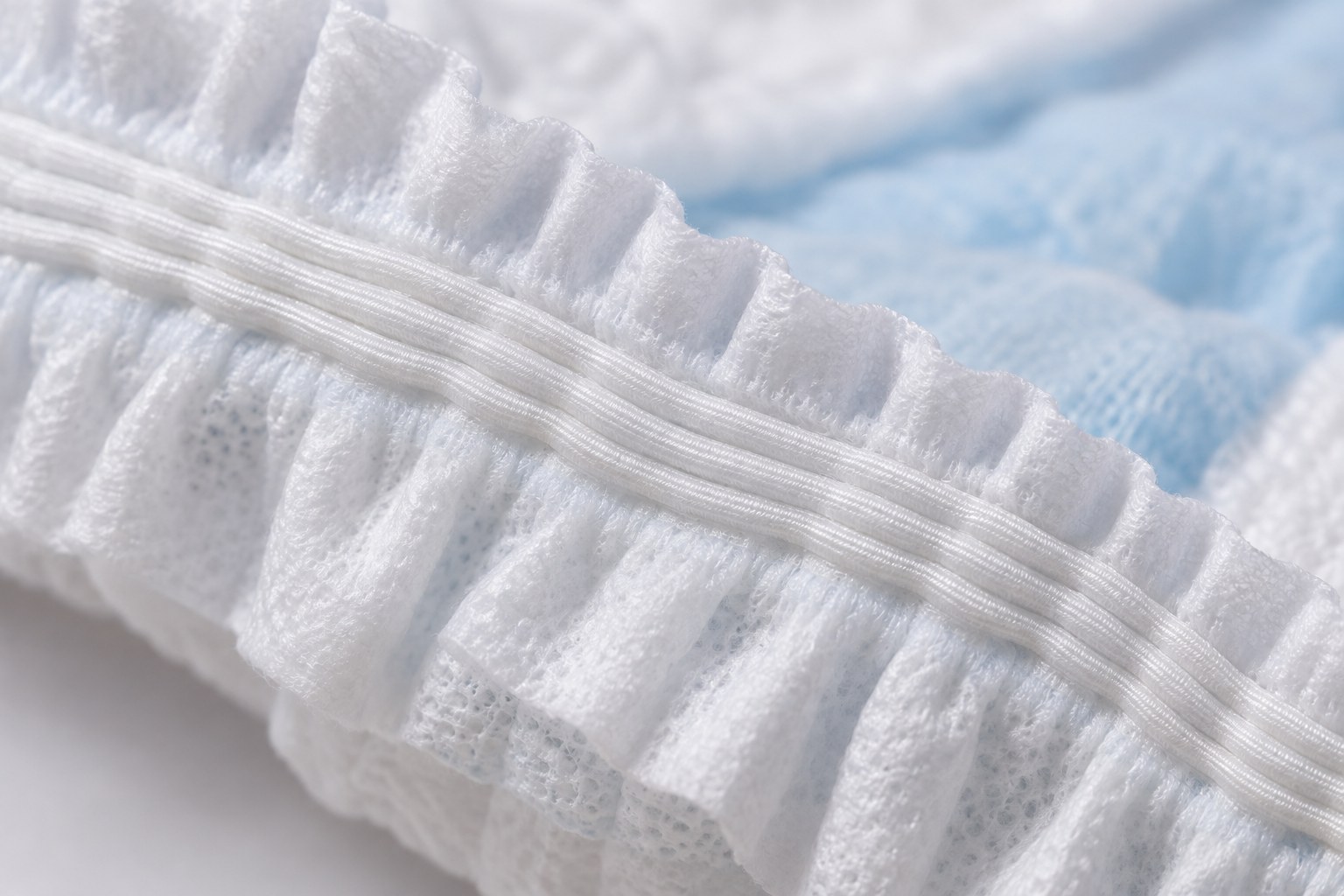
Understanding why tier-1 medical adhesives outperform generic commodity industrial glues requires examining the polymer rheology of block copolymers and the thermodynamics of elastic creep. The premier polymer class utilized in disposable hygiene is Styrenic Block Copolymers (SBC)—predominantly Styrene-Isoprene-Styrene (SIS) and Styrene-Ethylene-Butylene-Styrene (SEBS) compounded with hydrogenated hydrocarbon tackifying resins and high-purity medical-grade mineral oils. At room temperature, the polystyrene end-blocks associate into rigid, glassy nano-domains ($T_g pprox 100^\circ C$) that serve as physical cross-links, while the mid-block rubbery segments (isoprene or ethylene-butylene) provide extraordinary elastic recovery and flexibility.
The single most critical mechanical benchmark for elastic attachment adhesives is Creep Resistance. When four Lycra elastic strands in an adult brief’s standing leak barrier are stretched to 250% elongation and adhered between hydrophobic nonwoven webs, the elastic strands exert continuous, intense tensile retraction forces. If the adhesive possesses low cohesive strength or experiences plastic flow at physiological body temperatures (37°C), the elastic strands slowly pull back and detach within the bond line—a failure mode known as "elastic creep." As the elastic creeps, the standing barrier cuff collapses flat, resulting in catastrophic peripheral leakage when the patient voids in bed.
Shenghongda utilizes specialized Henkel Adhesives (Germany) Technomelt elastic attachment adhesives formulated with high-cohesion SIS polymers and high-softening-point tackifiers. Creep resistance is evaluated under strict laboratory protocols: bonded elastic specimens are suspended vertically under 250% elongation in an environmental oven maintained at 40°C (±1°C) for precisely 4 hours. Shenghongda’s Henkel formulations consistently achieve a creep score of less than 5.0% (meaning the elastic retains over 95% of its original bonded length), compared to commodity glues that frequently experience creep exceeding 25% to 45%. This exceptional creep resistance guarantees that 3D standing leak barriers remain fully upright and functional throughout 12-hour overnight wear.
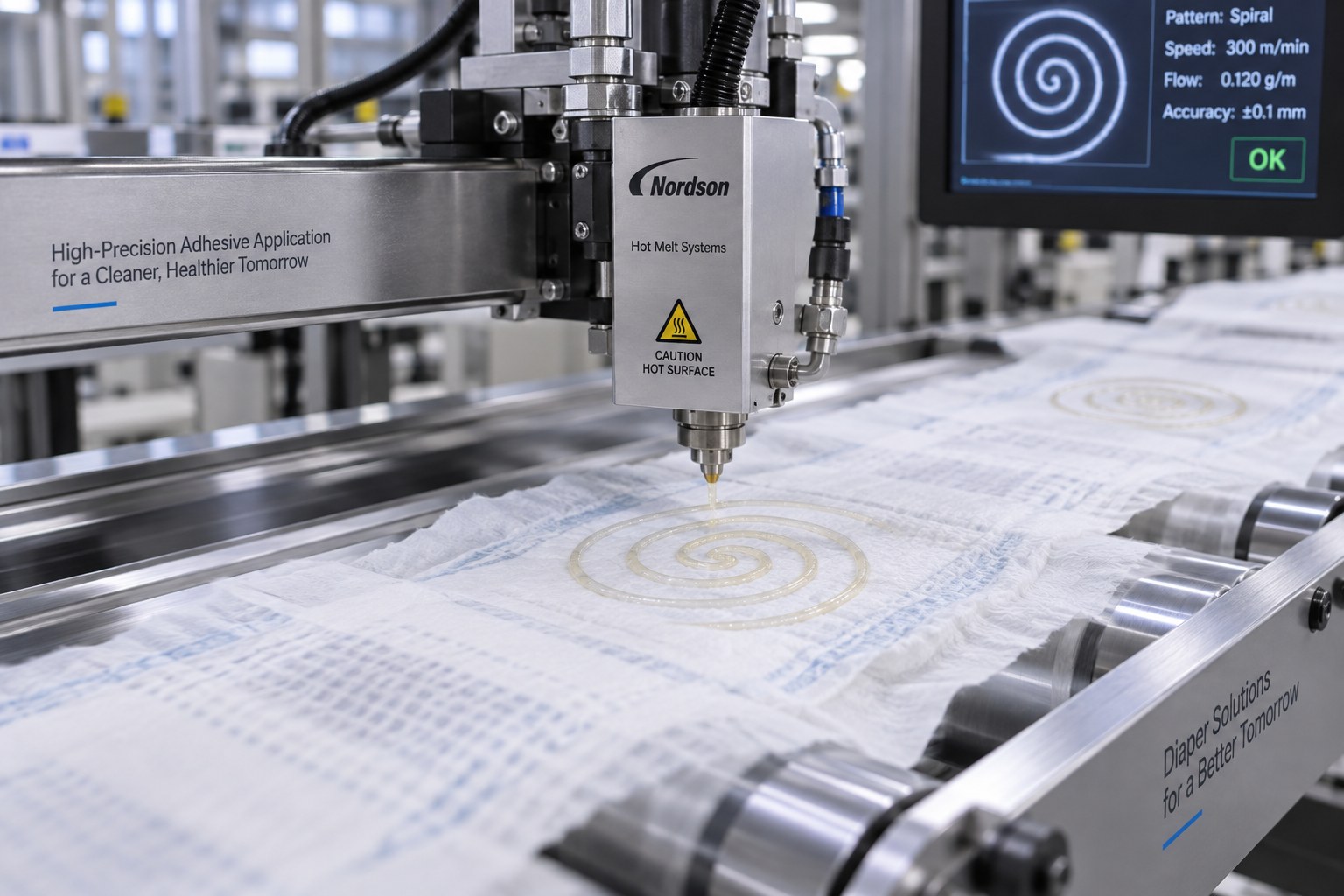
For chassis construction bonding, Shenghongda employs low-temperature application adhesives operating within an ultra-low thermal window of 135°C to 145°C (compared to 170°C for legacy glues). Lower application temperatures prevent thermal degradation and char formation in adhesive hoses, eliminate the pungent thermal odors associated with overheated polymers, and prevent thermal melt-through in ultra-thin 12 g/m² breathable polyethylene backsheet films. Applied via contactless multi-line or spiral spray nozzles from Nordson Corporation, the adhesive forms a flexible, micro-fibrous web that bonds securely without stiffening the chassis or blocking nonwoven breathability.
From a polymer physics standpoint, adhesive rheology is continuously characterized using Dynamic Mechanical Thermal Analysis (DMTA) across temperature sweeps from -40°C to +120°C. Henkel Technomelt formulations maintain a high storage modulus ($G' > 10^6$ Pa) across physiological body temperatures (35°C-40°C) with a low loss tangent ($ an \delta < 0.25$), preventing the viscous polymer flow and adhesive creeping that typically occurs when bedridden patients lie on wetted cores for extended hours.
| Technical Parameter | Generic Industrial Hot-Melt | Standard Commodity Diaper Glue | Henkel Technomelt (Shenghongda Spec) | Clinical & Manufacturing Advantage |
|---|---|---|---|---|
| Polymer Base Chemistry | EVA / Rosin Ester tackifier | Standard SBS / Hydrocarbon resin | Medical-Grade SIS / SEBS Block Copolymer | Superior elasticity, odorless, zero toxic monomers |
| Elastic Creep Resistance (4h @ 40°C) | > 35% (Severe cuff collapse) | 15% - 25% (Moderate creep) | < 5.0% (Verified high cohesion) | Guarantees 3D standing barriers stay upright 12+ hours |
| Application Temperature Window | 170°C - 185°C (High thermal odor) | 155°C - 165°C | 135°C - 145°C (Low application temp) | Prevents PE film burn-through & eliminates glue odor |
| Peel Adhesion (Nonwoven to PE) | 1.5 - 2.2 N/25mm (Delamination risk) | 2.8 - 3.2 N/25mm | ≥ 4.2 N/25mm (Fiber-tear bond) | Eliminates chassis delamination during patient movement |
| ISO 10993 Biocompatibility | Untested / High VOC release | Basic cytotoxicity pass | ISO 10993-5 Grade 0; ISO 10993-10 Pass | Clinically non-cytotoxic, non-irritating, non-sensitizing |
| California Proposition 65 | Potential phthalate & VOC contamination | Generic compliance declaration | Certified Lead < 5 ppm, Phthalates < 50 ppm | 100% legal indemnity against chemical lawsuits in USA |
3. Automated Hot-Melt Application Systems: Nordson Melters, Gear Pumps & Machine Vision
Precise application of hot-melt adhesives at commercial line speeds exceeding 450 to 500 units per minute requires advanced automated dispensing robotics. At Shenghongda’s 8,000 square meter Quanzhou manufacturing center, all 16 full-servo converting lines are equipped with state-of-the-art adhesive melters, precision metering gear pumps, and contactless dispensing applicator heads engineered by American industry leader Nordson Corporation.
Adhesive pellets are automatically transferred from sealed storage containers into Nordson tankless melt-on-demand systems. Unlike legacy tank melters that maintain 50 to 100 liters of molten adhesive at elevated temperatures for days—leading to progressive polymer oxidation, viscosity drift, and burnt char formation—Nordson tankless melters melt only the exact volume of adhesive required for immediate production. Independent multi-stream positive-displacement gear pumps, driven by closed-loop digital servo motors synchronized with converting line speed encoders, meter adhesive volume within an exacting tolerance of ±2% across all machine speeds from startup jog to 500 meters per minute.
For elastic strand attachment, Shenghongda utilizes Nordson Universal and SureWrap contactless spray nozzles. As four continuous Lycra spandex strands travel through high-speed guide combs, high-velocity vortex air streams wrap microscopic filaments of molten adhesive 360 degrees around each individual elastic thread before it contacts the nonwoven web. This complete 360-degree adhesive sheath provides impenetrable mechanical anchorage, ensuring zero elastic creep under 250% elongation. For chassis construction, Nordson Signature wide-web spray nozzles apply a feather-light spiral pattern (1.5 to 2.5 g/m²) that provides high peel adhesion without occluding micropores in the breathable polyethylene backsheet.
To eliminate adhesive pressure fluctuations across high-speed acceleration and deceleration cycles, each applicator station is equipped with automated closed-loop pressure transducers linked to the master PLC. If converting line speed increases from 100 m/min to 450 m/min, digital servo gear pumps dynamically adjust fluid displacement in under 15 milliseconds, maintaining exact glue add-on weights across variable line dynamics and preventing localized heavy glue deposits.
Inline quality assurance is maintained by multi-camera Cognex high-speed digital machine vision systems equipped with multi-spectral polarized LED illumination. High-speed optical algorithms inspect 100% of finished diaper chassis in real-time, verifying:
- Adhesive Spray Pattern Uniformity: Infrared thermal sensors inspect adhesive laydown width, verifying continuous edge-to-edge coverage without glue voids.
- Bleed-Through Surveillance: High-resolution optical sensors detect excess hot-melt or resin bleed-through onto the topsheet surface down to 0.2 mm² area.
- Elastic Strand Anchorage: Machine vision cameras verify continuous strand alignment and zero elastic snap-back or detachment along the cuff line.
- Foreign Particulate Contamination: Inspecting finished chassis for dark specks, charred adhesive particles, or foreign fibers.
4. Analytical Laboratory Verification, Chemical Purity & CNAS Testing Regimes
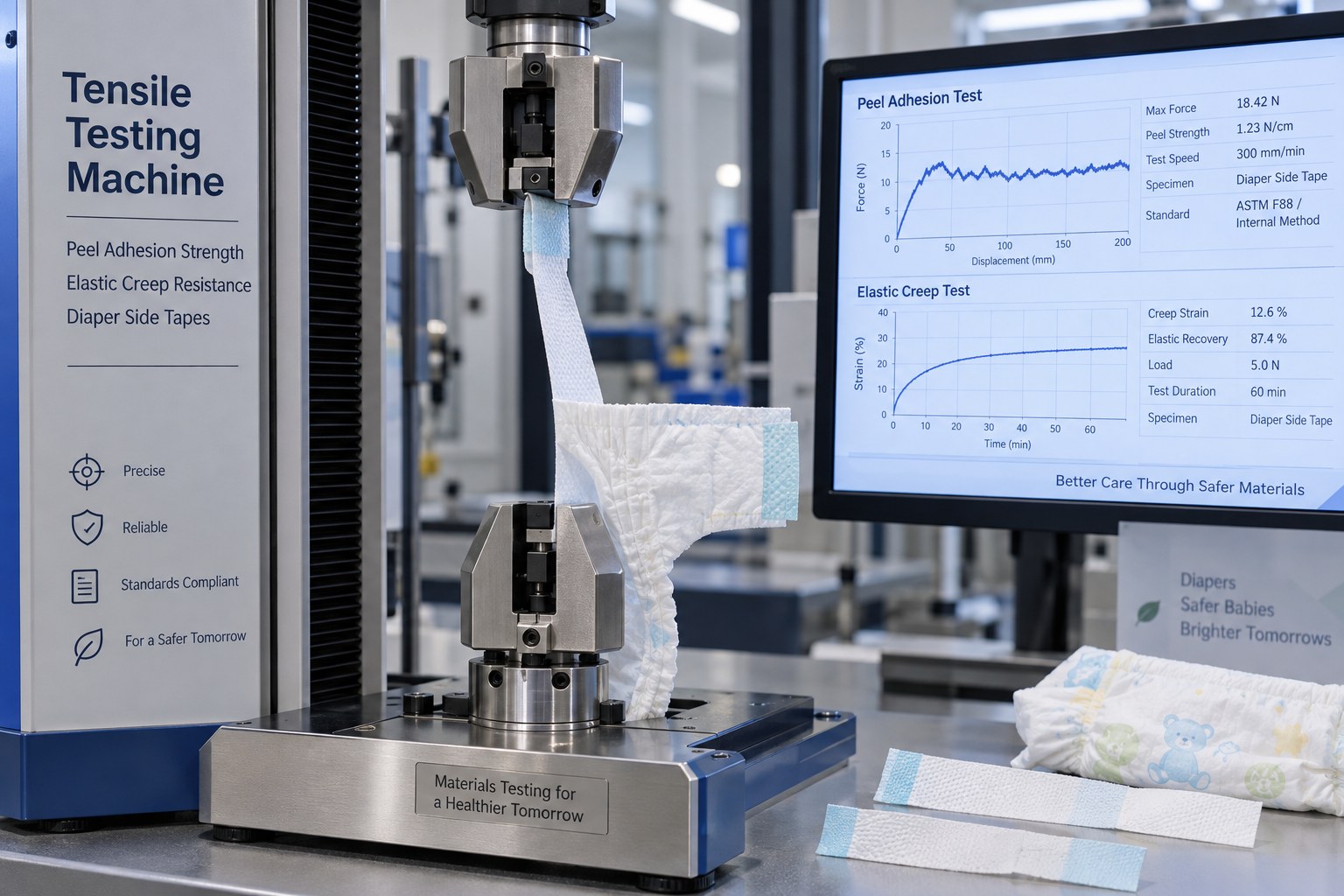
To substantiate technical claims during healthcare tender evaluations and regulatory audits, all hot-melt adhesives utilized at Shenghongda undergo exhaustive empirical testing in our in-house testing facility operated under strict CNAS National Accreditation and ISO/IEC 17025 Accredited accreditation. Our testing regimen bridges standardized physical rheological testing with biological biocompatibility assays, providing brand owners with unassailable empirical proof of performance.
A primary mechanical benchmark for elastic attachment adhesives is the 4-Hour Creep Resistance Test at 40°C. In our specialized materials testing laboratory, bonded elastic specimens (comprising four Lycra strands adhered between SMS nonwoven layers) are elongated to 250%, mounted onto vertical calibration boards, and placed into convection ovens maintained at 40°C (±0.5°C) for precisely 4 hours. Following thermal conditioning, the retraction distance of the elastic ends is measured under optical comparators; Shenghongda’s Henkel Technomelt formulations consistently exhibit creep values below 5.0%, ensuring that standing barrier cuffs maintain full vertical tension throughout extended overnight wear.
Peel adhesion strength is quantified on dual-column universal tensile testing machines in accordance with ASTM D1876 (T-Peel Test) and EDANA NWSP 130.1 protocols. 25 mm wide test strips of nonwoven topsheets laminated to microporous polyethylene backsheets are peeled apart at a crosshead speed of 300 mm/min. Shenghongda’s construction adhesives deliver peel values exceeding 4.2 N/25mm width, producing complete nonwoven fiber-tear failure rather than clean adhesive delamination, ensuring the diaper chassis remains intact during aggressive user movement.
Thermal stability and viscosity aging are evaluated in accordance with ASTM D4499 protocols. Adhesive samples are maintained at 160°C in open glass beakers for 72 hours, with viscosity monitored via Brookfield Thermosel rotational viscometers at 20-minute intervals. Henkel Technomelt lots exhibit viscosity drift of less than ±3.5% with zero surface skinning, charring, or color darkening, guaranteeing that molten glue remains clean and free of nozzle-plugging carbonized particulates.
Biological safety is verified in accordance with ISO 10993 standards. In vitro cytotoxicity testing (ISO 10993-5) using L929 mouse fibroblast cell cultures confirms cell viability exceeding 90% (Grade 0 reactivity). Dermal irritation and delayed skin sensitization assays (ISO 10993-10) demonstrate zero erythema or edema reactions. Analytical chemical screening via Headspace Gas Chromatography-Mass Spectrometry (GC-MS) confirms complete compliance with California Proposition 65 and OEKO-TEX Standard 100 Class I thresholds, certifying total absence of benzene, toluene, formaldehyde, and phthalate plasticizers.
| Performance & Safety Metric | Generic Industrial Hot-Melt | Henkel Technomelt (Shenghongda Standard) | Clinical & Consumer Impact |
|---|---|---|---|
| Elastic Strand Creep @ 40°C | 25% - 40% (Cuffs sag and leak) | < 5.0% (Maintains 95% retention) | Guarantees zero leg leaks during overnight wear |
| Thermal Degradation & Char | Frequent nozzle clogs & black specks | Zero char; thermal stability > 48h | Eliminates particulate contamination on diapers |
| Adhesive Bleed-Through Risk | Frequent strike-through (Scratchy feel) | Zero bleed-through (Contactless spray) | Preserves cloud-soft skin feel; zero irritation |
| 180° Peel Adhesion (N/25mm) | 1.5 - 2.5 N (Chassis delaminates) | ≥ 4.2 N/25mm (Fiber-tear bond) | Maintains structural core integrity under stress |
| ISO 10993 Biocompatibility | Untested / Cytotoxic risk | Certified ISO 10993-5 Grade 0 Pass | Safe for direct contact with compromised skin |
| Volatile Odor Profile | Pungent chemical / burnt smell | Completely odorless medical grade | Enhances unboxing experience for premium retail brands |
5. Commercial Economics, Ocean Freight Logistics & Sinosure Trade Financing
In the competitive global personal hygiene marketplace, material quality and chemical engineering must align seamlessly with international trade economics. Although medical-grade Henkel Technomelt hot-melt adhesives represent an incremental cost per metric ton over generic industrial glues, their superior cohesion and low-temperature application efficiency yield substantial net savings across the finished product bill of materials. By utilizing advanced Nordson contactless spray nozzles, Shenghongda optimizes adhesive add-on weights to 1.8 to 2.2 g/m²—reducing overall glue consumption by 15% to 20% while achieving higher peel strength and zero bleed-through.
Furthermore, the high thermal stability and zero bleed-through of our adhesive systems play an essential role in high-density maritime container shipping. When finished diapers are compressed under multi-stage hydraulic vacuum packaging systems to achieve maximum container loading payloads (over 94,000 adult diapers or 410,000 baby diapers per 40HQ container), inferior commodity glues can bleed through porous nonwovens under prolonged maritime compression, causing diapers to stick together in the pack and tear upon unboxing. Shenghongda’s Henkel formulations eliminate blocking and adhesive transfer entirely, ensuring individual diapers release effortlessly from retail polybags even after 35 days of transpacific container transit.
Shipping from our primary container terminals at Xiamen Port (UN/LOCODE: CNXMN) and Quanzhou Port (UN/LOCODE: CNQZ) to major international destination ports—including Valencia, Rotterdam, Hamburg, Los Angeles, Manzanillo, and Buenaventura—this volumetric packaging optimization reduces effective ocean shipping freight costs by $0.018 to $0.026 USD per unit. On an annualized commercial contract of 20 million units, this single engineering advantage saves overseas brand owners over $400,000 USD in ocean shipping freight.
To eliminate temperature-induced adhesive degradation during maritime transit through equatorial sea lanes, Shenghongda equips export containers with digital temperature and relative humidity USB data loggers. These autonomous sensors continuously log hold conditions at 15-minute intervals, providing overseas quality directors with an unbroken environmental audit trail confirming that interior container temperatures remained safely below the 50°C adhesive blocking threshold throughout ocean transit.
Furthermore, Shenghongda provides overseas clients with comprehensive trade liquidity support backed by China Export & Credit Insurance Corporation (Sinosure). For established retail chains, medical tender contractors, and healthcare distributors with audited financial standing, Shenghongda extends flexible credit terms, including Open Account (OA) 30, 60, and 90-day settlement structures. Under Sinosure underwriting, overseas buyers defer capital outlay until containers have safely cleared destination customs and reached regional distribution centers, optimizing cash flow and working capital efficiency.
6. Cleanroom Environmental Control, Bioburden Governance & ISO 13485 Standards
The handling, melting, and application of hot-melt adhesives in personal care manufacturing requires strict environmental sanitation and thermal hygiene control. In substandard manufacturing environments where adhesive melters are operated with open tank lids in dusty ambient air, airborne dust and environmental particulates settle into molten glue reservoirs, forming black abrasive char specks that clog application nozzles and scratch sensitive patient skin. Operating in strict alignment with ISO 13485:2016 Medical Devices Quality Management System standards, Shenghongda maintains pharmaceutical-grade environmental controls across its entire 8,000 square meter Quanzhou manufacturing complex.
All 16 full-servo converting lines are enclosed within a certified Class 100,000 cleanroom workshop (equivalent to ISO Class 8 under ISO 14644-1). Centralized industrial HVAC dehumidification systems continuously maintain workshop ambient temperature between 20°C and 24°C and relative humidity strictly between 45% and 60%, preventing electrostatic cling and eliminating hygroscopic clumping of raw polymer granules. The cleanroom operates under continuous positive air pressure differentials (+15 to +25 Pascals) relative to surrounding staging zones, preventing the infiltration of unconditioned outdoor dust, environmental humidity, and airborne insects.
Incoming air undergoes three-stage filtration—coarse pre-filters, medium bag filters, and terminal High-Efficiency Particulate Air (HEPA) filters delivering an air exchange rate of more than 20 cycles per hour. Operators entering the converting floor must pass through automated three-stage airlocks, don lint-free static-dissipative jumpsuits, hairnets, and sterile nitrile gloves, and complete a 30-second automated high-velocity air shower cycle. Daily microbial monitoring is executed using active air samplers, settle-plate nutrient agar sedimentation, and contact rodac swabs across conveyor belts, rotary cutting dies, and packaging chutes. Across all commercial production lots, our total viable aerobic microbial bioburden is guaranteed below 20 CFU/g—a level tenfold cleaner than the 200 CFU/g limit permitted by international consumer hygiene standards—with absolute zero detection of Staphylococcus aureus, Pseudomonas aeruginosa, or fungal contaminants.
7. Strategic Sourcing Due Diligence Roadmap & Buyer Action Checklist for Adhesive Auditing
For international hygiene brand owners, healthcare tender managers, and procurement executives seeking to evaluate a prospective manufacturer’s adhesive systems and structural integrity, Shenghongda recommends the following 7-step operational due diligence roadmap:
- Step 1: Audit Adhesive Brand Specifications & Tier-1 Sourcing
Demand verified documentation proving direct procurement contracts with tier-1 global adhesive manufacturers (Henkel Adhesives (Germany) Technomelt or Bostik). Verify manufacturer Certificates of Analysis (CoA) confirming polymer base chemistry (SIS/SEBS) and softening point.
- Step 2: 40°C Elastic Creep Testing & Barrier Cuff Integrity
Require certified laboratory test reports verifying elastic strand creep resistance strictly below 5.0% after 4 hours at 40°C. Confirm that standing leg barrier cuffs maintain full vertical tension under sustained body heat exposure.
- Step 3: Factory Automation & Contactless Spray Dispensing Inspection
Inspect the manufacturing facility’s adhesive dispensing systems: verify Nordson tankless melt-on-demand units, positive-displacement gear pumps, and contactless spray applicators that prevent PE backsheet thermal burn-through.
- Step 4: ISO 10993 Biocompatibility & Chemical Screening Verification
Request independent laboratory verification (SGS, TÜV, or Eurofins) confirming ISO 10993-5 cytotoxicity compliance (Grade 0), ISO 10993-10 skin sensitization pass, and complete compliance with California Proposition 65 VOC limits.
- Step 5: High-Density Container Loading & Sinosure Credit Setup
Collaborate with Shenghongda's logistics engineers to simulate high-density vacuum compression load plans for 40HQ ocean containers. Finalize maritime shipping schedules from Xiamen Port and apply for Sinosure Open Account (OA) credit facilities to optimize working capital during product rollout.
- Step 6: Real-World In-Use Packaging Integrity & Shelf Life Auditing
Establish ongoing quality surveillance reviewing diaper unboxing ease, absence of packaging blocking, and long-term adhesive bond stability in high-humidity destination warehouse environments. Shenghongda provides full technical support and batch traceability for every export container.
- Step 7: Adhesive Tank Maintenance & Inline Filter Replacement Protocols
Audit the factory's preventative maintenance logs for adhesive equipment: verify that Nordson inline melt filters (100-mesh) are replaced weekly and heated hoses undergo ultrasonic solvent flushes every 500 operating hours to eliminate char buildup.