
1. The Global Nonwoven Fabrics Landscape & Hygiene Sourcing Dynamics
Nonwoven fabrics constitute the primary tactile, structural, and barrier interface of modern disposable absorbent hygiene products. In a typical adult incontinence brief, baby diaper, or feminine sanitary napkin, nonwoven textiles comprise over 50% of the total external surface area—encompassing the user-facing hydrophilic topsheet, the fluid-channeling Acquisition Distribution Layer (ADL), the hydrophobic standing leg barrier cuffs, and the cloth-like outer backsheet lamination. For international personal care brand owners and healthcare distributors, nonwoven fabric selection dictates consumer tactile preference, clinical skin compatibility, and liquid management efficacy.
The global nonwovens sector represents a multi-billion dollar industrial polymer market governed by continuous technological evolution and intense raw material trade dynamics. In 2026, hygiene brand owners face an intricate procurement landscape characterized by two competing nonwoven technologies: conventional Spunbond-Meltblown-Spunbond (SMS / Spunbond) nonwovens and high-loft Through-Air Bonded (ATB / Air-Through) nonwovens. While spunbond nonwovens offer high tensile strength, fine filament diameters, and exceptional barrier properties at low basis weights, through-air bonded nonwovens deliver unmatched 3D cloud-like loft, luxurious cashmere softness, and instantaneous fluid strike-through speed.
Navigating this technical landscape requires deep polymer engineering expertise. Sourcing sub-standard nonwovens manufactured with unrefined polypropylene resins or unstable surfactant coatings leads directly to catastrophic product failures: surfactant wash-off causes repeated urinary voids to pool on the topsheet, fiber shedding abrades sensitive skin, and low hydrostatic head resistance in barrier cuffs results in immediate side leakage. Quanzhou Shenghongda Hygiene Products Co., Ltd. resolves these challenges through direct strategic partnerships with Tier-1 global nonwoven manufacturers, converting premium nonwoven grades across 16 full-servo converting lines under ISO 13485:2016 and ISO 9001:2015 standards.
By pairing precision in-house surfactant testing with continuous inline optical inspection, Shenghongda supplies world-class personal care articles across OEM Adult Diapers with Tapes, Baby Diapers OEM Manufacturing, Adult Incontinence Pull-Up Pants, and Feminine Sanitary Napkins Factory, providing global B2B clients with unyielding product differentiation and superior consumer loyalty across 88 export nations.
Simultaneously, international regulatory scrutiny regarding synthetic microfibers, chemical finishes, and circular economy lifecycles is reshaping nonwoven procurement. In the European Union, the Ecodesign for Sustainable Products Regulation (ESPR) and Single-Use Plastics (SUP) frameworks demand full transparency regarding chemical finishes and polymer purity. Importers must demonstrate that nonwoven topsheets and backsheets are entirely free of alkylphenol ethoxylates (APEO), per- and polyfluoroalkyl substances (PFAS), and hazardous optical brighteners. By partnering directly with bluesign-certified and OEKO-TEX compliant nonwoven extruders, Shenghongda guarantees complete chemical safety across all converted webs.
Furthermore, our engineering team collaborates closely with raw material resin suppliers to ensure all nonwoven webs comply fully with European REACH chemical safety regulations, OEKO-TEX Standard 100 Class I (safe for infant skin), and strict California Proposition 65 consumer chemical thresholds.
2. Polymer Morphology: Spunbond Polypropylene vs Air-Through Bicomponent Fibers
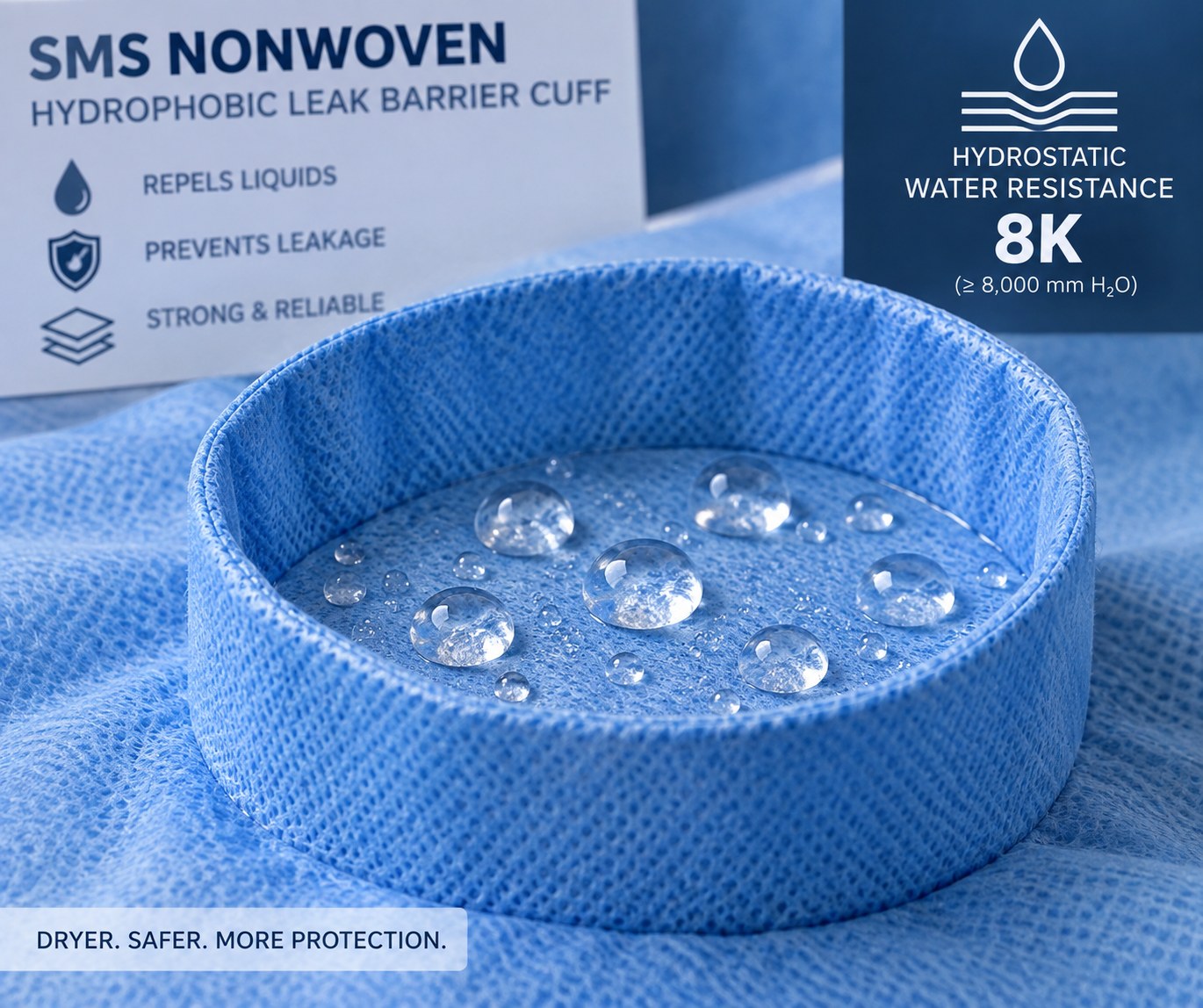
Understanding the performance divergence between nonwoven technologies requires examining fiber spinning physics and thermal bonding mechanisms. Standard Spunbond (SB) nonwovens are manufactured by melt-spinning virgin isotactic polypropylene (PP) pellets ($[-CH_2-CH(CH_3)-]_n$) through microscopic spinneret dies, aerodynamically drawing the filaments into continuous microfibers (1.8 to 2.2 denier), and thermally bonding the random web using heated calender rollers with point-embossed patterns. In standing barrier leg cuffs, Shenghongda deploys Spunbond-Meltblown-Spunbond (SMS) composite nonwovens: the central meltblown layer consists of ultra-fine sub-micron fibers (0.5 to 2.0 µm) that form a dense, tortuous barrier meshwork capable of withstanding intense hydrostatic water column pressures exceeding 220 mm H₂O while remaining fully permeable to air.
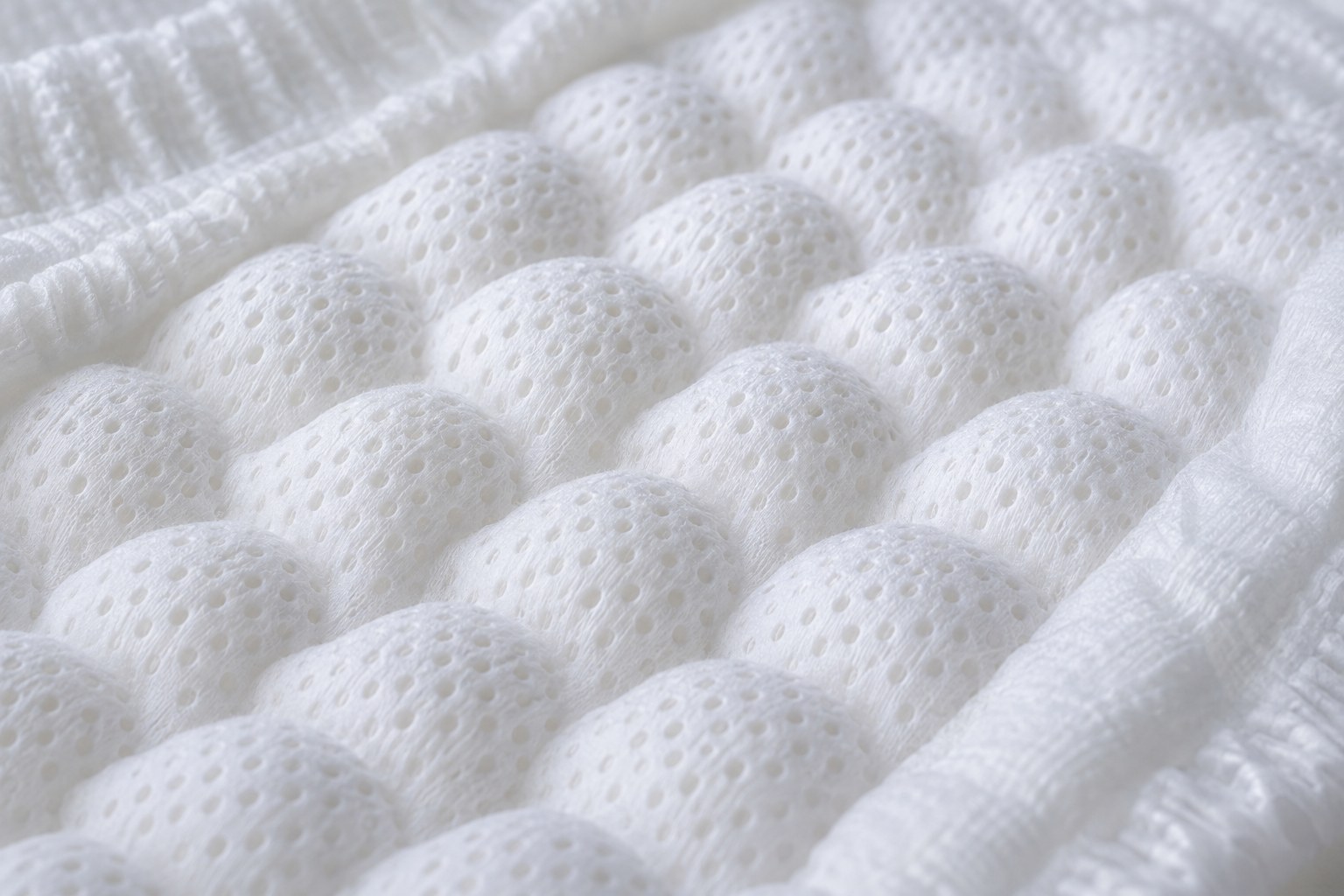
In contrast, premium topsheets and Acquisition Distribution Layers (ADL) utilize Air-Through Bonded (ATB) nonwovens manufactured from specialized bicomponent (bico) synthetic fibers. Bicomponent fibers feature a concentric core-sheath morphology: a high-melting-point core of Polyethylene Terephthalate (PET, melting point ~255°C) or Polypropylene (PP, melting point ~165°C) encapsulated within a lower-melting-point sheath of Polyethylene (PE, melting point ~130°C). During manufacturing, the carded web of bico fibers passes through a specialized through-air oven where heated air melts only the outer PE sheath. As the sheath melts, it fuses at fiber intersection points, while the unaffected PET core maintains rigid structural springiness.
This air-through thermal bonding process creates an extraordinarily open, 3D high-loft fibrous matrix with low density (0.04 to 0.06 g/cm³) and high specific volume. Unlike calendered spunbond—where up to 20% of the surface area is flattened into dense, hard thermal bond points—ATB nonwovens possess zero hard bond points, delivering a cloud-soft, cushion-like tactile texture that completely eliminates skin chafing. Furthermore, the open-pore void spaces between bicomponent fibers act as an instantaneous hydraulic surge capacitor: when sudden voids occur, fluid passes through the topsheet in under 1.5 seconds without pooling.
Hydrophilic surface chemistry is strictly engineered in Shenghongda’s nonwoven specifications. Because pure polypropylene and polyethylene are naturally hydrophobic, fibers must be coated with specialized hydrophilic surfactant finishes. Low-grade nonwovens utilize cheap fugitive surfactants that wash off after the first void, leaving the diaper hydrophobic and causing subsequent voids to run off the surface. Shenghongda enforces durable, multi-strike surfactant formulations tested under EDANA Standards NWSP 070.7 protocols, certifying that topsheets maintain strike-through times under 2.0 seconds across five consecutive saline insults, with zero surfactant cytotoxicity under ISO 10993-5 standards.
In addition, Shenghongda deploys 3D micro-embossed and perforated topsheet nonwovens. Using ultrasonic embossing pins, the nonwoven surface is shaped with macro-funnel apertures that physically guide viscous fluids—such as liquid bowel movements in infants or heavy menstrual flow—downward into the core while preventing backward rewetting.
| Technical Parameter / Feature | Standard PP Spunbond Nonwoven | Air-Through Bicomponent (ATB) Nonwoven | SMS Hydrophobic Barrier Nonwoven | Clinical & Manufacturing Significance |
|---|---|---|---|---|
| Fiber Polymer Morphology | 100% Monocomponent Polypropylene (PP) | PE/PET Core-Sheath Bicomponent Fiber | Spunbond-Meltblown-Spunbond Composite | Dictates loft, softness, and hydrostatic barrier |
| Thermal Bonding Methodology | Hot calendar point-embossed rollers | Hot air-through oven (Zero hard points) | Calendar thermal point bonding | ATB eliminates hard bond points; cloud-soft feel |
| Fabric Specific Volume (Loft) | 3.5 - 5.0 cm³/g (Flat, thin web) | ≥ 12.5 cm³/g (Ultra-high loft 3D pad) | 3.2 - 4.5 cm³/g (Dense barrier web) | High loft accelerates fluid surge capture |
| Initial Liquid Strike-Through | 2.8 - 4.0 seconds (Lister test) | < 1.5 seconds (Instantaneous wicking) | Hydrophobic (Resists fluid penetration) | Prevents surface pooling during heavy voids |
| Hydrostatic Head Pressure | < 80 mm H₂O (Permeable to liquid) | < 50 mm H₂O (Highly porous) | ≥ 220 mm H₂O (Impenetrable water dam) | Guarantees zero leg leak in standing barriers |
| Handle-O-Meter Softness Rating | 42 - 58 grams (Moderate stiffness) | < 18 grams (Cashmere-like softness) | 35 - 45 grams (Flexible barrier cuff) | Prevents friction, chafing, and skin redness |
3. High-Speed Web Tension Control, Ultrasonic Bonding & Web Guiding Dynamics
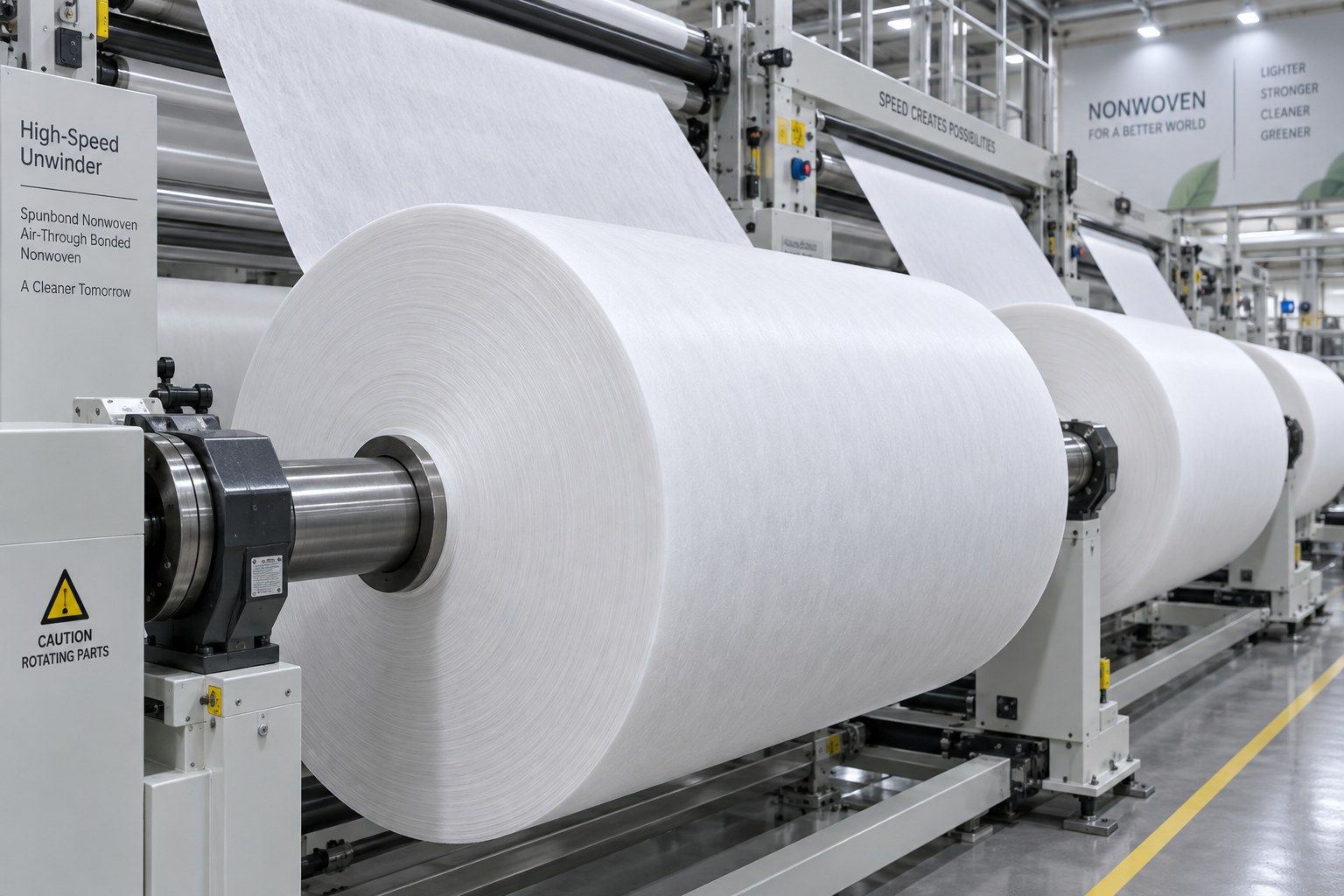
Converting delicate through-air bonded and SMS nonwoven fabrics at commercial line speeds exceeding 450 to 500 units per minute requires converting machinery of the highest engineering caliber. High-loft ATB nonwovens are mechanically sensitive: if web tension is too high, the 3D loft of the bicomponent fibers is permanently crushed, destroying the open-pore void structure and increasing fabric density. Conversely, if web tension is too low, the web will wander laterally, resulting in edge curl, folding wrinkles, and misaligned core lamination. At Shenghongda’s Quanzhou converting center, our 16 full-servo converting lines incorporate advanced web handling and dynamic tension control technology.
Each unwinding station is equipped with motorized digital servo unwinds coupled to low-inertia dancer arms and high-resolution load cells. Operating over high-speed industrial Ethernet networks, the system maintains web tension within an exacting tolerance of ±0.1 Newtons per meter across the entire parent roll diameter (from 1,500 mm down to the core). Automated pneumatic edge-guiding sensors from German specialist Erhardt+Leimer continuously monitor the lateral web position at 500 Hz, instantly steering the unwinding spindle to keep web alignment within ±0.5 millimeters of centerline.
Furthermore, joining raw material rolls during continuous high-speed production requires seamless automated butt-splicing. Shenghongda’s converting lines feature zero-speed automated rotary butt splicers. When a parent roll approaches exhaustion, the trailing web is clamped, cleanly sheared, and spliced to the leading edge of a new roll using ultra-thin double-sided nonwoven splicing tape in under 0.1 seconds, without slowing down the converting line. This eliminates the massive web breaks and thermal glue burning associated with manual roll changeovers.
In standing leg cuff assembly, Shenghongda replaces traditional thermal or adhesive bonding with high-frequency ultrasonic welding technology. Ultrasonic horns vibrating at 20 kHz to 35 kHz create localized acoustic cavitation at the molecular level, welding the hydrophobic SMS nonwoven layers and encapsulating the multi-strand Lycra elastic threads without the need for hot-melt adhesives. This eliminates the stiff, brittle glue seams characteristic of older manufacturing methods, producing standing barrier cuffs that remain ultra-soft, supple, and non-irritating against sensitive perineal skin.
Continuous inline vision systems monitor web integrity 100% in real-time, instantly identifying and ejecting any units exhibiting pinholes, web creases, slitting burs, or surface contamination.
4. Surfactant Durability Testing, Multiple Strike-Through Kinetics & Biocompatibility Validation
The chemical and biological safety of nonwoven fabrics in direct skin contact is non-negotiable. Because personal hygiene and medical incontinence articles are worn for hours at a time against fragile skin, nonwoven surfaces must deliver instantaneous fluid penetration while remaining completely non-toxic, hypoallergenic, and non-sensitizing. Shenghongda’s CNAS-accredited testing laboratory conducts rigorous physical, chemical, and biological testing on every incoming lot of nonwoven fabric.
A primary performance test is the Repeated Liquid Strike-Through Time evaluation, performed in accordance with EDANA Standards NWSP 070.7 harmonized standards. Utilizing an automated Lister AC strike-through tester, a standardized 5.0 ml dose of 0.9% physiological saline is discharged onto the nonwoven specimen resting on standardized reference filter paper under calibrated hydrostatic head pressure. The elapsed time for the liquid to penetrate the web is recorded electronically with millisecond precision. To evaluate surfactant durability, this test is repeated five consecutive times on the same nonwoven sample at 5-minute intervals. While inferior nonwovens show dramatic strike-through slowdown after the second insult (increasing from 2 seconds up to 8+ seconds due to surfactant wash-off), Shenghongda’s premium ATB nonwovens maintain strike-through times under 1.8 seconds across all five insults.
Equally critical is the Wetback (Rewet) evaluation conducted under EDANA NWSP 070.1. Following liquid insults, a mechanical dead-weight delivering 0.5 psi (3.5 kPa) is applied over calibrated filter paper for two minutes. Shenghongda's nonwoven topsheets consistently yield wetback values below 0.05 grams, confirming that liquid is permanently locked beneath the topsheet and cannot migrate backward to macerate fragile stratum corneum skin.
Biocompatibility and chemical toxicity testing are executed in strict alignment with ISO 10993 international medical device biological evaluation standards:
- In-Vitro Cytotoxicity (ISO 10993-5): MEM elution assays using L929 mouse fibroblast cell cultures confirm cell viability exceeding 90% with Grade 0 reactivity, verifying complete absence of leachable toxic finishes.
- Skin Irritation & Sensitization (ISO 10993-10): Primary dermal irritation assays and Guinea Pig Maximization Tests (GPMT) demonstrate zero erythema, edema, or delayed contact sensitization.
- California Proposition 65 & Heavy Metals Screen: Inductively Coupled Plasma Mass Spectrometry (ICP-MS) and GC-MS screens verify that nonwoven webs are 100% free of lead, cadmium, arsenic, organotin compounds, phthalate plasticizers, and toxic formaldehyde residues.
Through this comprehensive chemical and biological governance, Shenghongda ensures that every nonwoven substrate converted in our facility provides medical-grade clinical safety and gentle consumer protection.
| Performance & Commercial Factor | Standard Spunbond Nonwoven Topsheet | Shenghongda Air-Through (ATB) Topsheet | Consumer & Retail Brand Advantage |
|---|---|---|---|
| Tactile Skin Softness | Standard nonwoven texture (Slightly coarse) | Cashmere-like 3D cloud softness (<18g) | Instant premium tactile feel drives retail sales |
| Repeated Strike-Through Speed | Slows after 2nd void (>4.5s; wash-off) | Consistently fast (<1.8s across 5 voids) | Guarantees zero surface wetness during surges |
| Skin Friction & Chafing Index | Higher friction coefficient (COF ≥ 0.40) | Ultra-low friction coefficient (COF ≤ 0.18) | Eliminates contact diaper rash & skin redness |
| Chassis Drape & Flexibility | Slightly stiff; crinkles during movement | Flows smoothly with body movement | Silent, discreet, underwear-like drape |
| Container Payload (40HQ) | 70,000 - 74,000 pcs (Standard pack) | 92,000 - 96,000 pcs (High-density vacuum pack) | +28% higher piece count; $0.024/pc ocean freight savings |
| Retail Brand Margin Potential | Standard commodity pricing (15-20%) | High-growth premium retail segment (28-40%) | Drives significantly higher basket ring and profitability |
5. Cost-per-Square-Meter Economics, Slitting Tolerances & Nonwoven Sourcing Hedging Strategies
In high-volume disposable hygiene manufacturing, nonwoven fabrics represent between 20% and 35% of total raw material procurement expenditure. Because nonwovens are purchased on a per-square-meter or per-metric-ton basis, minor variations in fabric basis weight (grams per square meter, g/m²), slitting width tolerances, and polypropylene resin spot prices exert a direct, measurable impact on unit production costs and gross profit margins.
Polypropylene resin—the primary petrochemical feedstock of spunbond and meltblown nonwovens—trades as an international commodity influenced by crude oil futures, propane dehydrogenation plant operating rates, and polymer export flows. To protect our overseas OEM/ODM partners from price shocks, Shenghongda’s procurement division maintains strategic volume contracts with premier regional nonwoven roll-goods mills and polymer producers (such as Sinopec, Formosa Plastics, and Toray Advanced Materials). By maintaining rolling 60-day buffer inventories of standardized nonwoven master rolls and hedging resin price swings, Shenghongda guarantees stable finished product pricing even during volatile petrochemical market cycles.
Furthermore, slitting and rewinding precision plays a crucial role in eliminating manufacturing waste. When parent rolls of nonwoven fabric are slit into converting widths (e.g., 180 mm for standing cuffs or 220 mm for topsheets), slitting width tolerances must be strictly maintained within ±0.5 mm. If slitting blades produce ragged edge burrs or inconsistent widths, the nonwoven web will oscillate on high-speed converting lines, causing hot-melt adhesive overspray, nonwoven edge folding, and excessive line downtime. Shenghongda mandates laser-guided shear slitting systems for all roll goods, ensuring razor-sharp roll edges, perfect wound-roll cylindrical geometry, and zero core slippage.
To maintain peak material efficiency and competitive price points, Shenghongda implements automated inline trim recycling systems. Clean spunbond and air-through edge trims generated during high-speed rotary slitting are captured via pneumatic cyclone ducts, densified in continuous shredder-extruders, and re-pelletized into high-grade secondary polypropylene chips. This closed-loop recovery protocol reduces raw material waste below 1.2%, directly supporting our corporate carbon reduction targets and lowering converting overhead for our private-label brand partners.
In addition, Shenghongda optimizes basis weight efficiency through advanced micro-denier spinning technology. By utilizing fine filaments (1.5 to 1.8 denier) rather than coarse fibers, our Tier-1 suppliers achieve equivalent tensile strength and opacity at a lower basis weight (e.g., reducing spunbond backsheet lamination webs from 15 g/m² down to 12 g/m² without sacrificing tear resistance). This basis weight optimization directly lowers raw material consumption, decreases container shipping weight, and supports sustainable corporate ESG goals.
6. Cleanroom Contamination Prevention, Electrostatic Dissipation & In-Line Machine Vision Surface Auditing
The manufacturing environment in which nonwoven fabrics are handled and converted is a critical determinant of medical-grade hygiene compliance. Nonwoven fabrics are porous, fibrous materials possessing high surface area and significant static electrical charge generation during unwinding. If converting operations take place in poorly controlled factory environments, nonwoven webs act as electrostatic dust magnets, attracting airborne particulates, pollen, insect fragments, and microscopic fibers that can contaminate the finished product and trigger severe skin allergies in end users.
At Shenghongda’s 8,000 square meter Quanzhou manufacturing complex, all 16 full-servo converting lines operate inside an audited Class 100,000 (ISO Class 8) cleanroom facility conforming strictly to ISO 13485:2016 and ISO 9001:2015 standards. The converting hall features positive atmospheric pressure differentials (+15 to +25 Pa) relative to surrounding staging areas, preventing unconditioned exterior air from infiltrating the production core. The cleanroom air is circulated through primary pre-filters, secondary medium-efficiency filters, and terminal HEPA filters delivering over 20 air changes per hour. Temperature is controlled at 22°C ± 2°C and relative humidity is maintained between 50% and 60%—an optimal band that naturally suppresses static electricity buildup while preventing moisture absorption by hydrophilic finishes.
Personnel protocols are pharmaceutical grade: operators enter through two-stage airlocks, don lint-free anti-static suits, hairnets, masks, and conductive footwear, and undergo 30-second high-velocity air showers. Raw material rolls are unpacked in dedicated outer airlocks and cleaned with HEPA vacuum de-dusters before entering the cleanroom floor.
In-line quality assurance is maintained by multi-camera Cognex CCD digital machine vision inspection systems illuminated by synchronized LED strobe arrays. The vision cameras inspect 100% of the moving nonwoven web across its entire width at converting line speeds up to 500 meters per minute. Sophisticated image-processing algorithms detect surface anomalies with sub-millimeter precision:
- Minute Foreign Fibers & Dark Specks: Flags any dark fiber, carbon speck, or foreign particulate contamination down to 0.2 mm² surface area.
- Nonwoven Pinholes & Web Tears: Detects micro-pinholes or thin spots in hydrophobic barrier nonwovens that could allow fluid leakage.
- Surfactant & Coating Irregularities: Monitors optical reflectance to verify uniform hydrophilic coating across the entire topsheet width.
- Slitting Edge Quality: Verifies clean, burr-free web edges to prevent edge-curl or tension tears.
Any non-conforming product detected by the machine vision system is tracked along the conveyor belt by PLC encoders and automatically ejected into a locked defect containment bin by a high-speed pneumatic reject gate, ensuring that zero contaminated articles ever reach the automated packaging station.
7. Strategic Sourcing Due Diligence Roadmap & Buyer Action Checklist for Nonwovens
For international procurement directors, healthcare tender managers, and consumer goods brand executives seeking to evaluate a diaper manufacturer's nonwoven fabric sourcing and quality control, Shenghongda recommends the following 7-step operational due diligence roadmap:
- Step 1: Audit Nonwoven Technology & Polymer Specifications
Review the prospective manufacturer's technical data sheets (TDS): verify whether topsheets utilize through-air bonded (ATB) bicomponent fibers or generic spunbond, and confirm that standing barrier cuffs incorporate Spunbond-Meltblown-Spunbond (SMS) composites.
- Step 2: Multiple Strike-Through & Surfactant Durability Testing
Demand certified laboratory test reports under EDANA Standards NWSP 070.7 verifying repeated liquid strike-through times across 5 consecutive insults, ensuring that surfactants are non-fugitive and do not wash off after initial wetting.
- Step 3: Biocompatibility & Chemical Safety Review
Review the manufacturer's certified GLP testing reports for in-vitro cytotoxicity (ISO 10993-5), skin irritation (ISO 10993-10), and complete compliance with California Proposition 65 thresholds (lead < 100 ppm, phthalates < 0.1%, zero toxic VOCs).
- Step 4: Converting Line Web Handling & Vision Inspection Audit
Inspect the manufacturing facility’s converting machinery: verify that lines utilize digital closed-loop servo tension controls (±0.1 N/m) and multi-camera machine vision inspection to prevent web wrinkles, tears, and particulate contamination.
- Step 5: Ultrasonic Bonding Verification on Barrier Cuffs
Confirm whether standing leg barrier cuffs are bonded using high-frequency ultrasonic welding rather than rigid hot-melt adhesives, ensuring soft, non-abrasive leg contact for sensitive skin.
- Step 6: High-Density Container Loading & Sinosure Credit Setup
Collaborate with Shenghongda's logistics engineers to simulate high-density vacuum compression load plans for 40HQ ocean containers. Finalize maritime shipping schedules from Xiamen Port and apply for Sinosure Open Account (OA) credit facilities to optimize working capital during product rollout.
- Step 7: Structured Post-Production Quality Auditing
Implement incoming batch inspection protocols at destination distribution centers: verify tactile softness ratings, barrier cuff hydrostatic resistance, and packaging integrity to ensure continuous brand excellence.